
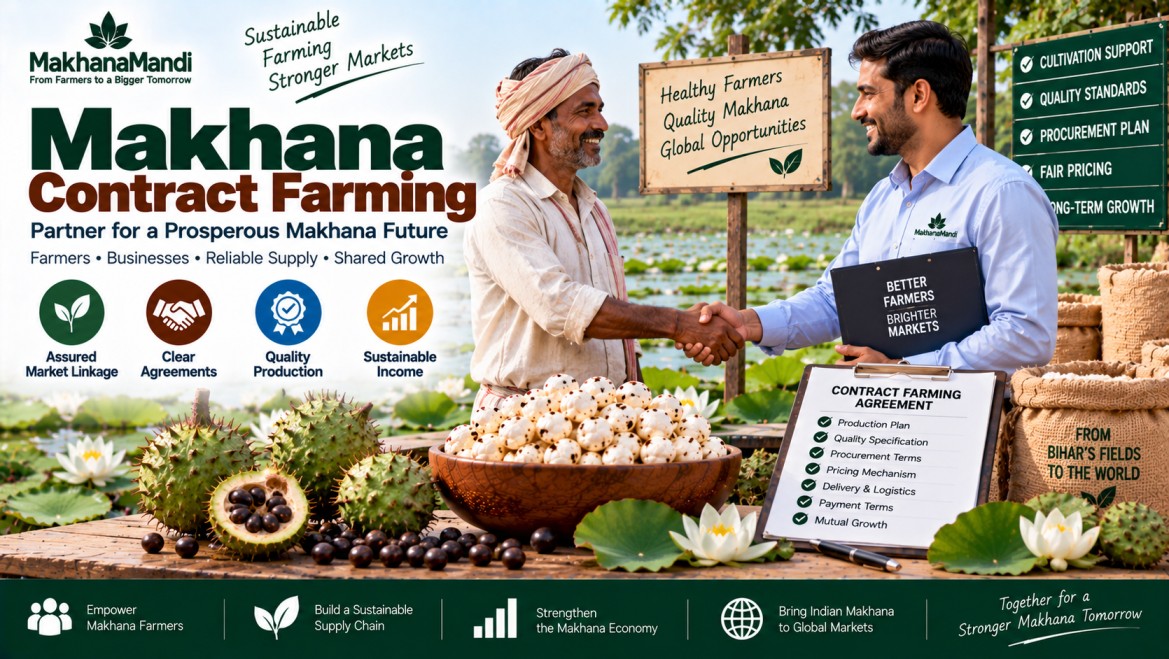
Makhana contract farming is a structured arrangement in which farmers and buyers or business partners agree in advance on important aspects of cultivation, production requirements, quality expectations, procurement and commercial coordination. For the Makhana sector, such arrangements can help connect production with dependable market demand while giving buyers greater visibility into sourcing.
What Is Makhana Contract Farming?
Makhana contract farming refers to a planned relationship between growers and a buyer, processor, trader, exporter or other business participant. The exact commercial arrangement can vary. It may cover cultivation practices, expected production, quality specifications, procurement timing, pricing mechanisms, inspection requirements, logistics and payment terms.
A contract should clearly define the responsibilities of each party. Farmers should understand what they are expected to produce and how quality will be assessed. Buyers should define procurement requirements, delivery expectations and commercial terms clearly before production commitments are made.
How Does Makhana Contract Farming Work?
A practical arrangement normally begins with identifying the product requirement and the production capability of the farming side. The parties can then discuss the expected quantity, quality, procurement period, location and commercial terms.
- Requirement identification: The buyer defines the quantity, quality and procurement requirement.
- Farmer or production partner selection: Suitable growers or producer groups are identified based on location and capability.
- Production planning: Cultivation and production expectations are discussed before the relevant production cycle.
- Quality specification: The parties establish measurable quality expectations and acceptance criteria.
- Procurement planning: Collection, delivery, inspection and logistics responsibilities are established.
- Commercial agreement: Pricing or pricing methodology, payment terms and other obligations are documented.
- Post-production coordination: Quantity, quality and delivery are verified before final settlement.
Why Contract Farming Can Matter in the Makhana Market
Makhana moves through a supply chain involving farmers, processors, traders, wholesalers, exporters and other buyers. When production and procurement are coordinated earlier, businesses may have better visibility into sourcing requirements and farmers may have clearer information about potential demand.
However, contract farming does not automatically guarantee a particular market price or business outcome. Market conditions, quality, production volumes, logistics, demand and the terms of the individual agreement can all affect the final commercial result.
Key Market Factors for Makhana Buyers and Sellers
Makhana market conditions can change with supply, demand, quality, seasonality, procurement activity and regional availability. Buyers evaluating a contract-farming arrangement should therefore consider both the agreed commercial terms and the broader market environment.
- Current and recent Makhana market rates
- Expected production and available supply
- Quality and grade requirements
- Procurement timing
- Transportation and logistics costs
- Processing and sorting requirements
- Buyer demand and downstream market conditions
- Payment and settlement terms
For current market signals and available marketplace information, businesses can also review the Live Makhana Price page and compare active Makhana marketplace listings.
Quality Specifications Should Be Clear
Quality is one of the most important areas to define before entering a contract-farming arrangement. A buyer should avoid vague descriptions such as “premium quality” without explaining the characteristics that determine acceptance.
The agreement may need to address size or grade, cleanliness, moisture or storage requirements, processing condition, packaging, sorting and other measurable specifications relevant to the intended use.
Contract Farming for Processors, Wholesalers and Exporters
Processors and wholesalers may use coordinated sourcing to plan procurement volumes and maintain continuity of supply. Export-oriented businesses may also need consistent quality and documentation across procurement cycles.
For a buyer, the objective should be to establish a transparent sourcing arrangement rather than simply attempting to lock in the lowest possible purchase price. Clear specifications, realistic quantities and dependable communication can reduce misunderstandings between the production and buying sides.
How Buyers Can Evaluate a Potential Farming Partner
Before entering a commercial relationship, buyers should evaluate the production location, expected capacity, previous supply experience, quality consistency, ability to meet delivery requirements and clarity of business terms.
On MakhanaMandi, businesses can explore Makhana businesses and available marketplace opportunities to identify potential commercial connections. Where direct business networking is required, Connect Credits can help facilitate business connections through the marketplace.
Distributorship and Business Expansion Opportunities
Contract farming and distribution address different parts of the Makhana business chain. A business seeking wider market reach may separately explore distributorship opportunities in addition to its sourcing strategy.
Businesses interested in offering or seeking Makhana distributorship can explore Makhana distributorship opportunities. Where a business is ready to publish a distributorship opportunity, purchasing a distributorship listing can provide a dedicated marketplace route for presenting that opportunity to relevant businesses.
Questions Buyers Should Ask Before an Agreement
- What quantity is expected during the procurement period?
- How will quality and grade be measured?
- When and where will the product be delivered?
- Who is responsible for transportation and related costs?
- What pricing mechanism applies if market conditions change?
- What are the inspection and rejection procedures?
- When and how will payment be made?
- What happens if the agreed quantity cannot be supplied?
Frequently Asked Questions
Is Makhana contract farming the same as a normal purchase agreement?
No. A contract-farming arrangement generally involves production planning or commitments made before procurement, while a normal purchase can simply involve buying available product under agreed commercial terms.
Does contract farming guarantee the Makhana price?
Not necessarily. The result depends on the specific agreement. Parties should clearly document whether the price is fixed, linked to a market reference, or determined through another agreed mechanism.
Can businesses use contract farming for wholesale supply?
Yes, where the parties agree on suitable production, quality, quantity, procurement and commercial terms. The arrangement should be structured around the actual requirements of the business.
Where can buyers check current Makhana market information?
Buyers can review the Live Makhana Price page and active marketplace listings for available MMX information and opportunities.
Conclusion
Makhana contract farming can provide a framework for closer coordination between production and procurement. Its usefulness depends on clear quality standards, realistic production commitments, transparent commercial terms and regular communication between the parties. Buyers and sellers should evaluate the broader market context rather than relying on a contract alone, and should document their responsibilities clearly before entering a commercial arrangement.