
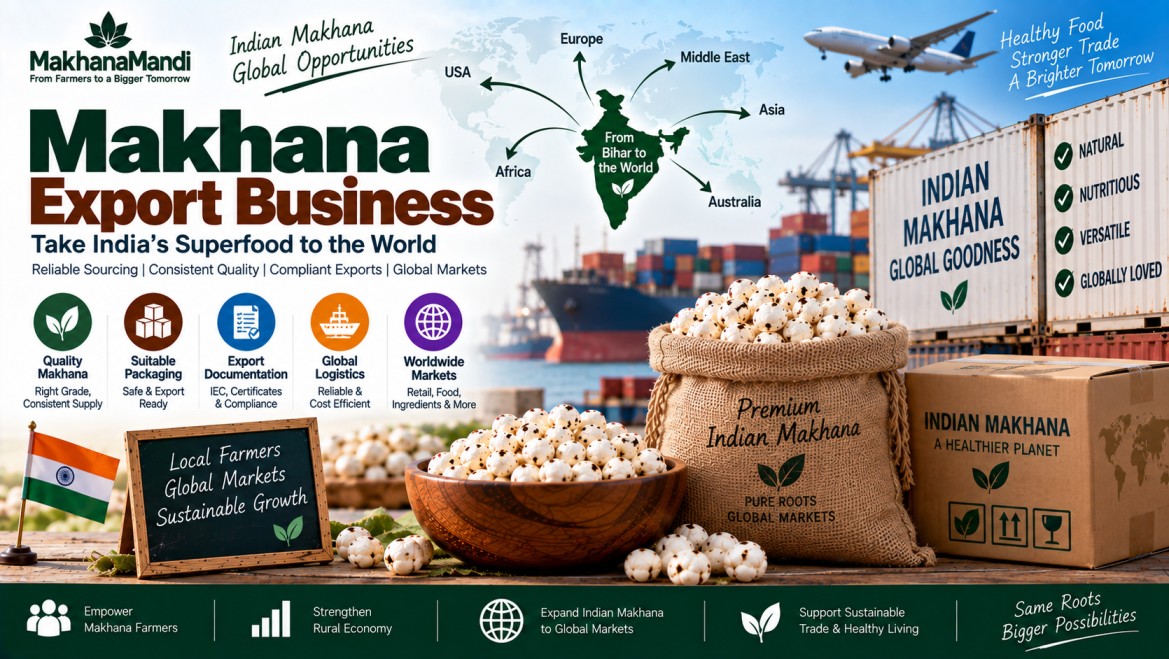
A Makhana export business connects Indian Makhana supply with buyers in international markets. A sustainable export operation requires more than finding overseas demand: exporters need reliable sourcing, consistent quality, suitable packaging, documentation, logistics, commercially workable payment terms, and a clear understanding of the destination market.
Market Opportunity
Makhana has applications in retail foods, snacks, ingredient supply, and other food businesses. An exporter can operate as a trader, processor, branded-product supplier, or a combination of these models.
Choosing an Export Business Model
Trading and Bulk Export
A trader can source Makhana from suppliers and sell commercial quantities to overseas buyers. This model depends heavily on procurement relationships, working capital, quality control and logistics.
Processed and Packaged Makhana
Processors can supply roasted, flavoured or otherwise prepared products. This can create additional value but also introduces greater requirements around processing, packaging, labelling and quality management.
Branded Export Products
A branded product strategy can target international retail consumers, distributors or specialty food channels. It requires stronger attention to packaging, brand positioning, destination-market requirements and distribution.
Sourcing Makhana
Reliable sourcing is one of the most important foundations of an export business. Before accepting an international order, establish the required grade, quality specification, quantity, packaging, delivery schedule and commercial terms.
Exporters can research commercial supply through MakhanaMandi's Makhana suppliers in Bihar marketplace page and identify relevant companies through the business directory.
Quality and Packaging
International buyers may specify requirements for size, grade, cleanliness, consistency, packaging and shelf life. Exporters should document agreed specifications and establish suitable inspection and quality-control procedures.
Packaging must protect the product during handling and transportation and should satisfy applicable destination-market rules. Labelling requirements vary between markets and should be verified before shipment.
Export Documentation and Compliance
Exporters need to understand India's current export procedures as well as the requirements of the destination country. Depending on the transaction, documentation can include commercial invoices, packing information, shipping documents, certificates and other regulatory records.
An Importer Exporter Code (IEC) is an important part of India's export framework. Businesses should verify current IEC and other export requirements through the relevant official authorities before beginning operations.
Finding International Buyers
Potential buyers can include importers, distributors, wholesalers, retailers, food manufacturers and specialty food businesses. Before accepting an order, exporters should verify the buyer's specifications, expected volume, payment terms, delivery responsibilities and destination requirements.
MakhanaMandi's marketplace listings can provide useful commercial context for understanding available Makhana supply and business activity in India.
Export Costs and Profitability
Export profitability should be calculated using the complete transaction economics. Costs may include procurement, processing, packaging, domestic transportation, documentation, freight, insurance where applicable, financing and other transaction expenses.
Exporters should avoid calculating profit from the difference between a supplier price and an overseas selling price alone. The full landed cost and payment cycle should be considered.
Practical Steps to Start
- Select the target market and customer type.
- Define the required Makhana specification.
- Develop dependable supplier relationships.
- Calculate procurement, processing, packaging and logistics costs.
- Verify current Indian export and destination-market requirements.
- Prepare suitable product and commercial documentation.
- Identify and qualify international buyers.
- Start with commercially manageable orders and establish repeat processes.
Frequently Asked Questions
Is Makhana export a good business opportunity?
It can be, particularly for businesses with reliable sourcing, quality-control capability, working capital and access to suitable international buyers. Profitability depends on the complete transaction economics and market conditions.
Can Makhana be exported from India?
Businesses can pursue Makhana exports from India subject to applicable Indian export procedures and the requirements of the destination market.
What is needed to start a Makhana export business?
A business needs a defined export model, dependable supply, appropriate product specifications, quality controls, suitable packaging, required documentation, logistics arrangements and qualified buyers.
Where can exporters find Makhana suppliers?
Exporters can use trade networks and commercial marketplaces. MakhanaMandi provides supplier and business information, including its Bihar supplier marketplace.
How should Makhana export profit be calculated?
Calculate procurement, processing, packaging, domestic logistics, export documentation, freight, financing and other applicable costs against the expected realised selling price.