
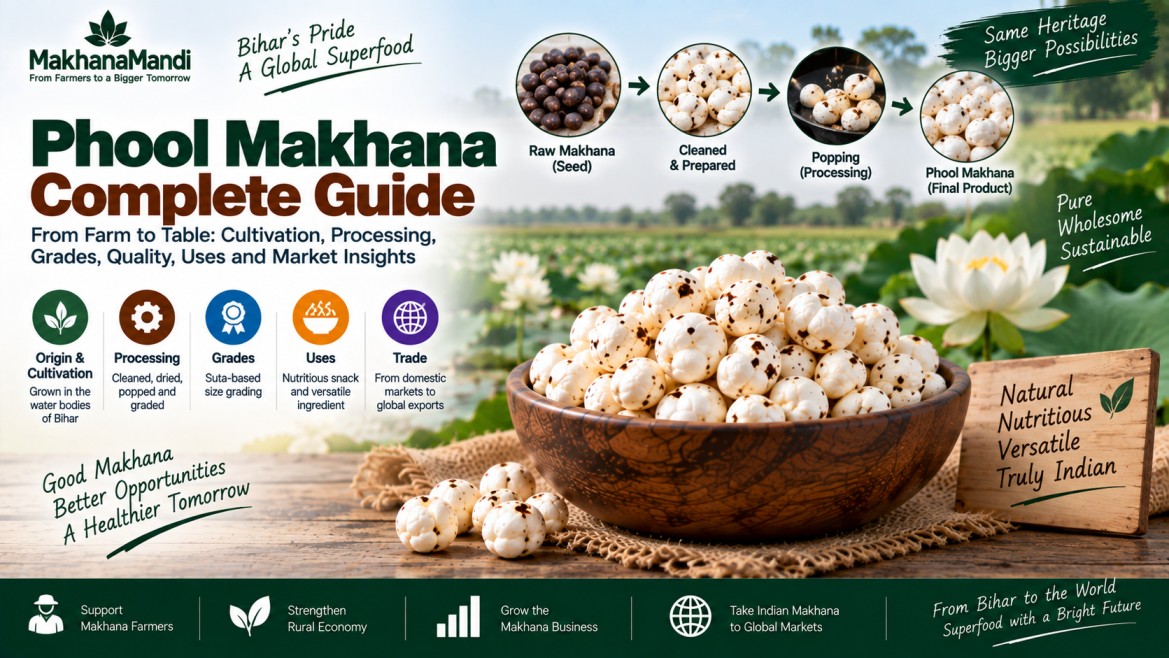
Phool Makhana is the edible popped seed of the aquatic plant Euryale ferox. It is widely associated with Bihar and has become an important food product in India's Makhana value chain, from cultivation and processing to domestic trade and exports.
Phool Makhana is commonly consumed as a roasted snack, but the wider Makhana business includes raw material sourcing, processing, grading, packaging, branding, wholesale trading and international distribution.
This guide explains what Phool Makhana is, how it is produced, how grades are used, what buyers should check and why product quality matters in the Makhana trade.
What is Phool Makhana?
Phool Makhana is the popped form of Makhana seed obtained from Euryale ferox. The seeds undergo processing that transforms the hard raw material into the familiar white, lightweight and edible popped product.
The term “Phool” refers to the characteristic popped appearance of the finished Makhana. Depending on processing quality and grading, individual pieces can vary considerably in size, shape, whiteness, cleanliness and breakage.
Where does Phool Makhana come from?
India is an important producer and trading market for Makhana, with Bihar playing a major role in the country's Makhana ecosystem.
The crop is associated with aquatic cultivation systems and is particularly important across parts of northern Bihar. The commercial supply chain connects farmers and raw-material suppliers with processors, traders, wholesalers, packaged-food businesses and exporters.
How is Phool Makhana produced?
The production of Phool Makhana involves several stages. The exact process can vary according to local practices, equipment and the intended product specification.
- Cultivation and harvesting of Makhana seeds
- Collection and cleaning of raw seeds
- Drying and preparation of the raw material
- Grading or sorting where applicable
- Controlled heating or roasting
- Popping of the seeds
- Removal of unsuitable or defective pieces
- Further grading and quality sorting
- Packaging for the intended market
Good processing and careful handling are important because the final appearance, texture, cleanliness and breakage level can directly affect commercial value.
What is the difference between raw Makhana and Phool Makhana?
Raw Makhana refers to the unpopped seed or raw material before it becomes the familiar edible popped product. Phool Makhana is the popped product obtained after processing.
This distinction is important when buying or selling Makhana because raw material and finished Phool Makhana can have different specifications, prices, handling requirements and intended uses.
How is Phool Makhana graded?
Commercial Makhana is commonly described using size grades. In the Makhana trade, “Suta” is used as a grading reference for diameter.
Size is an important commercial characteristic because larger and well-formed pieces can have different market demand and pricing from smaller or more broken pieces.
However, size alone does not determine the complete quality of a lot. Buyers should also consider colour, cleanliness, breakage, moisture, processing consistency and other agreed specifications.
Why does Makhana size matter?
Size affects appearance, product positioning and the suitability of Makhana for different applications.
Large, visually attractive pieces may be preferred for premium retail packs, while other grades may be suitable for different food-processing or wholesale requirements.
Buyers should therefore specify the required grade clearly rather than relying only on a general description such as “good quality Makhana.”
What makes good-quality Phool Makhana?
Quality should be evaluated against the intended use and agreed commercial specification. Important characteristics can include:
- Appropriate size grade
- Clean appearance
- Suitable colour
- Low visible contamination or foreign matter
- Controlled breakage
- Consistent processing
- Suitable moisture condition
- Proper packaging and handling
- Traceable origin where required
For commercial procurement, buyers should define measurable specifications before finalizing a purchase.
Phool Makhana for food and snack products
Phool Makhana can be consumed in several ways. It is commonly roasted and seasoned as a snack, and it can also be incorporated into recipes and packaged food products.
Commercial processors may use different roasting methods, flavours, oils, seasonings and packaging formats depending on their target market.
For businesses, the product specification should distinguish plain Phool Makhana from roasted, flavoured or otherwise processed products.
How should Phool Makhana be stored?
Phool Makhana is a low-moisture food product, but proper storage remains important for preserving quality.
Storage conditions should protect the product from moisture, contamination, pests, excessive heat and unsuitable handling. Packaging should provide appropriate protection for the expected storage and distribution environment.
For commercial quantities, businesses should establish suitable moisture-control, packaging and warehouse practices rather than assuming that a dry product requires no storage controls.
Phool Makhana packaging
Packaging requirements depend on the product, sales channel and destination market.
Retail products may be packed in consumer-oriented pouches, jars or other suitable formats. Wholesale and bulk transactions may use larger commercial packaging.
Packaging should protect the product from moisture, physical damage and contamination while supporting the labelling and traceability requirements applicable to the market.
Buying Phool Makhana in bulk
Bulk buyers should define the specification before requesting quotations. A useful buying specification can include:
- Product name and form
- Required Suta grade
- Quantity
- Packaging type
- Quality parameters
- Origin requirements
- Production or harvest year where relevant
- Delivery location
- Minimum order quantity
- Price basis and payment terms
Comparing quotations without standardizing the specification can produce misleading price comparisons because two apparently similar Makhana lots may have materially different grades or quality characteristics.
Phool Makhana price factors
The price of Phool Makhana can vary according to grade, quality, supply conditions, processing costs, packaging, quantity and market demand.
Higher-grade or better-sorted material may command a different price from smaller, mixed or broken material. Wholesale prices can also differ from retail prices because of differences in quantity, packaging, logistics and commercial terms.
For current market information, buyers and sellers should compare actual available listings and clearly defined specifications rather than relying on a single generic Makhana price.
Phool Makhana business opportunities
The Makhana value chain offers opportunities across multiple stages, including cultivation, raw-material aggregation, processing, grading, wholesale trading, branded packaged foods and exports.
Businesses entering the sector should choose their position in the value chain carefully and understand sourcing, quality control, working capital, packaging, logistics and buyer requirements.
A reliable supplier network and clear product specifications are particularly important for businesses handling commercial quantities.
Phool Makhana for export
Phool Makhana is also part of India's agricultural and food export ecosystem. Exporters need to consider the exact product form, destination-country requirements, food compliance, packaging, labelling, documentation and logistics.
Export requirements should be checked for the specific destination and product rather than applying one universal checklist to every international shipment.
How buyers can evaluate a Phool Makhana supplier
Buyers should evaluate suppliers on more than quoted price. Useful factors include:
- Business identity and contact information
- Product specification
- Available quantity
- Grade consistency
- Quality documentation where applicable
- Packaging capability
- Origin information
- Delivery capability
- Commercial terms
- Past business experience and verification signals
For larger transactions, buyers should consider samples, specification confirmation and appropriate commercial due diligence before committing to a purchase.
Phool Makhana and the Makhana supply chain
Phool Makhana connects several participants in the Makhana economy. Farmers and raw-material suppliers provide the starting material, processors convert it into the finished product, and traders and distributors connect supply with domestic and international buyers.
Marketplaces can make this ecosystem easier to navigate by helping businesses discover suppliers, buyers, available quantities and product specifications.
Frequently asked questions
What is Phool Makhana?
Phool Makhana is the popped edible seed of the aquatic plant Euryale ferox. It is commonly sold as a food product and is an important part of the Makhana trade.
Is Phool Makhana the same as Makhana?
In common commercial usage, Phool Makhana refers to the popped edible product, while “Makhana” can be used more broadly to describe the crop, raw material or finished product depending on context.
What does Suta mean in Makhana?
Suta is a size-grading reference used in the Makhana trade. Buyers should specify the required grade clearly when purchasing commercial quantities.
Which factors affect Phool Makhana quality?
Important factors can include size, colour, cleanliness, breakage, moisture condition, processing consistency and packaging. The exact specification should be agreed between buyer and seller.
Can Phool Makhana be bought wholesale?
Yes. Phool Makhana is traded in wholesale and bulk quantities. Buyers should compare offers using a clearly defined grade, quality specification, quantity and packaging requirement.
Can Phool Makhana be exported?
Yes. Phool Makhana is part of India's food and agricultural export ecosystem. Exporters must check the current requirements applicable to the exact product and destination market.
Conclusion
Phool Makhana is more than a packaged snack: it is the finished product of a broader agricultural, processing and trading ecosystem. Understanding grade, quality, processing, packaging and commercial specifications helps buyers and businesses make better purchasing and selling decisions.
For businesses participating in the Makhana trade, reliable product information and transparent commercial specifications are essential for building efficient supply relationships.