
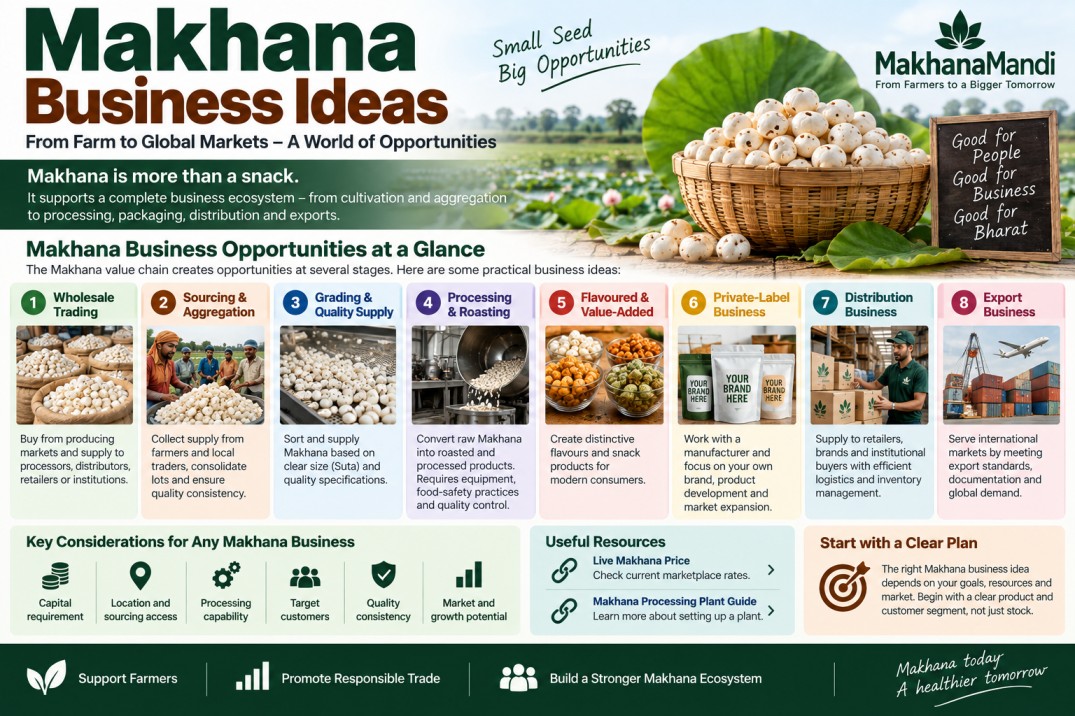
Makhana business ideas
Makhana is no longer only a traditional snack or regional agricultural product. It supports a broader business ecosystem that includes cultivation, aggregation, grading, processing, packaging, wholesale trading, distribution, private-label products and exports.
If you are researching Makhana business ideas, the right opportunity depends on your capital, location, sourcing access, processing capability, target customers and ability to maintain consistent quality. A practical business should begin with a clear product and customer segment rather than simply buying stock and hoping to find a buyer later.
Makhana business opportunities at a glance
The Makhana value chain creates opportunities at several stages:
- Raw Makhana aggregation and trading
- Grading and quality-based sourcing
- Wholesale supply
- Processing and roasting
- Flavoured and value-added Makhana products
- Consumer packaging and private-label manufacturing
- Distribution to retailers and institutional buyers
- Business-to-business sourcing and procurement
- Export-oriented Makhana supply
These are different businesses with different operational requirements. A trader does not need the same infrastructure as a processing plant, while a consumer brand has different requirements from a bulk distributor.
1. Makhana wholesale trading
Wholesale trading can be suitable for businesses that have access to reliable suppliers and buyers and understand commercial specifications such as grade, quality, quantity and delivery terms.
A wholesale trader can source Makhana from producing markets and sell to processors, distributors, retailers, brands or other institutional buyers. Working capital, quality inspection, storage and logistics become important parts of the business model.
Wholesale prices should not be treated as one fixed number. Grade, quality, location, quantity and commercial terms can change the value of a lot. Buyers can use the Live Makhana Price page for current marketplace context.
2. Makhana sourcing and aggregation
An aggregation business focuses on bringing together supply from farmers, local traders or other suppliers and preparing commercially suitable lots for larger buyers.
The main competitive advantage can be reliable sourcing, quality consistency, lot consolidation and dependable fulfilment. Businesses operating in this area need strong supplier relationships and a process for checking incoming material.
3. Makhana grading and quality-based supply
Businesses can create value by sourcing, sorting and supplying Makhana according to clearly defined size and quality specifications.
Makhana is commonly described using Suta-based size grades. Commercial buyers should understand the applicable grade specification and should not assume that a label such as premium or jumbo automatically represents a universal technical standard.
Consistency matters because buyers purchasing repeatedly need confidence that successive lots meet the agreed specification.
4. Makhana processing and roasting
Processing creates opportunities beyond raw commodity trading. Roasting and other processing operations can turn raw Makhana into products designed for different customer segments.
A processing business needs suitable equipment, process controls, food-safety practices, quality control, packaging capability and a dependable supply of suitable raw material.
Businesses considering a processing plant should first understand their target product, expected production volume, sourcing model and route to market. See the Makhana processing plant guide for related educational context.
5. Flavoured and value-added Makhana
Value-added Makhana products can target consumers looking for convenient packaged snacks. Possible product directions include savoury flavours, seasoning-based products and other differentiated snack formats.
This model requires more than a recipe. Product consistency, ingredient control, packaging, shelf-life considerations, food labelling, brand positioning and distribution all affect commercial viability.
6. Makhana private-label business
A private-label business can work with a processor or manufacturer while focusing its own resources on branding, product development, sales and distribution.
This can reduce the need to build a complete processing facility, but it increases the importance of selecting a capable manufacturing partner and maintaining consistent product specifications.
7. Makhana distribution business
Distributors connect suppliers and manufacturers with retailers, brands, institutional customers and other downstream buyers.
A successful distribution operation depends on route planning, inventory management, working capital, customer relationships and reliable fulfilment. Geographic coverage can become an important competitive advantage.
8. Makhana export business
Export-oriented businesses can source Makhana for international buyers, importers, distributors or food brands.
Export businesses need to understand destination-market requirements, product specifications, documentation, packaging, logistics, payment terms and applicable regulations. Requirements can differ by destination, so businesses should verify current rules before entering a particular market.
What do you need to start a Makhana business?
The requirements depend heavily on the business model. A trading operation and a processing unit should not be evaluated using the same checklist.
Business and legal setup
Choose an appropriate legal structure and complete the registrations, licences and tax requirements applicable to the planned activities and location.
Reliable sourcing
Identify suppliers capable of providing the required grade, quality and quantity. Do not depend on a single source unless the business has a clear contingency plan.
Quality control
Define the specifications you will buy and sell. Establish practical checks for size, cleanliness, breakage, moisture and other characteristics relevant to the product.
Storage
Storage conditions can affect product quality and inventory value. Businesses handling significant volumes should establish appropriate storage procedures before accumulating stock.
Working capital
Trading businesses may need capital for procurement, storage, packaging, transport and operating expenses before customer payments are received. The required amount depends on inventory turnover and commercial terms.
Customers and sales channels
Identify the buyer before scaling inventory. Potential customer groups include wholesalers, distributors, processors, retailers, food brands, institutional buyers and export-oriented businesses.
How to source Makhana for a business
Start by defining exactly what you need: product type, grade, quality, quantity, packaging, delivery location and commercial terms.
Then compare multiple suppliers rather than selecting an offer solely because it has the lowest quoted price. Supplier reliability, consistency, available quantity and fulfilment capability can be just as important.
The permanent Makhana Business Directory can help businesses discover participants in the Makhana trade ecosystem, while the Makhana Listings marketplace provides a place to explore current marketplace supply and demand.
How to find buyers for Makhana
Buyer acquisition should match the product and business model.
- Bulk suppliers can target wholesalers, processors, distributors and institutional buyers.
- Processors can target brands, retailers and consumer businesses.
- Private-label businesses can target retailers and online distribution channels.
- Exporters can develop relationships with overseas importers and distributors.
- Regional distributors can target retailers and food businesses in their service area.
Clear product specifications make business-to-business selling easier because buyers can understand exactly what is being offered.
Makhana business plan: what should it contain?
A practical Makhana business plan should cover the following:
- Business model and target customer
- Product and quality specification
- Sourcing strategy
- Processing or handling requirements
- Storage requirements
- Packaging and branding
- Expected procurement and selling volumes
- Working-capital requirements
- Logistics and delivery model
- Sales and customer-acquisition strategy
- Applicable legal, food-safety and regulatory requirements
- Key risks and contingency plans
The most useful plan is based on realistic procurement costs, operating expenses, expected selling prices and achievable sales volumes rather than optimistic assumptions.
Makhana business costs and commercial factors
Costs vary substantially between business models. A trader may have significant inventory and logistics costs, while a processor may additionally have machinery, labour, utilities, packaging and quality-control expenses.
Businesses should separately consider:
- Raw material procurement
- Processing and labour
- Packaging materials
- Storage
- Transportation and freight
- Testing and quality control
- Business registration and compliance
- Sales and marketing
- Working capital and payment cycles
- Equipment and maintenance where applicable
Wholesale market prices also change over time. Businesses should use current market information when building financial assumptions instead of relying on an old article or historical quotation.
Is Makhana business profitable?
Makhana can offer several business opportunities, but profitability is not automatic. It depends on sourcing efficiency, quality, inventory management, wastage, processing yield where applicable, logistics, customer acquisition, selling price and working-capital discipline.
A business can have a strong-looking selling price and still produce poor returns if procurement, storage, logistics or inventory costs are not controlled.
Should you start with trading or processing?
For a new entrepreneur, the choice should be based on capabilities and market access rather than assuming that processing is always more profitable.
Trading can require less processing infrastructure but may expose the business to working-capital and inventory risks. Processing can create additional value but introduces equipment, operational, quality-control and compliance requirements.
One sensible approach is to validate customer demand and sourcing relationships before making a large infrastructure investment.
Makhana business opportunities through MMX
MakhanaMandi is designed around the wider Makhana trade ecosystem, connecting marketplace information, listings and business discovery.
Businesses can use the permanent Listings page to understand current marketplace activity, the Live Makhana Price page to understand current price signals, and the Businesses directory to discover businesses participating in the ecosystem.
These pages should be treated as changing marketplace resources. Individual offers can have limited validity, so long-term business research should rely on the permanent MMX hubs rather than old links to individual listings.
Frequently asked questions
What are the best Makhana business ideas?
Potential models include wholesale trading, aggregation, grading, processing, roasted Makhana, value-added products, private-label products, distribution and export-oriented supply. The best option depends on capital, sourcing access, capabilities and target customers.
How can I start a Makhana business?
Start by choosing a specific business model, identifying your target customers, defining product specifications, developing reliable sourcing, estimating working capital and understanding applicable registrations and regulatory requirements.
Do I need a processing plant to start a Makhana business?
No. Trading, sourcing, aggregation, distribution and private-label models can operate without owning a processing plant. Processing businesses have additional infrastructure and operational requirements.
How do I find Makhana suppliers?
Define your required product and specifications first, then compare suppliers based on quality, quantity, reliability and commercial terms. The permanent Makhana Business Directory can help with business discovery.
How do I find Makhana buyers?
Identify customer segments that match your product, such as wholesalers, processors, distributors, retailers, brands, institutional buyers or export businesses. Clear specifications and dependable fulfilment improve B2B selling.
Is there a subsidy for starting a Makhana business?
Government schemes and subsidies can change, and eligibility depends on the scheme, applicant, location and proposed activity. Businesses should verify current official eligibility, application procedures and funding conditions before including a subsidy in their business plan.
How much investment is required for a Makhana business?
There is no single investment figure. A small trading operation, distribution business, private-label brand and processing plant have very different capital requirements. Build the estimate from your intended scale, inventory, equipment, working capital and operating costs.
Where can I check current Makhana prices?
Use the Live Makhana Price page for current MMX marketplace price signals and the Listings page to explore current marketplace activity.
Conclusion
Makhana offers opportunities across the value chain, from sourcing and wholesale trading to processing, packaging, distribution and exports. The strongest business model is the one that matches your resources with a clearly defined customer need and a reliable supply of consistent-quality Makhana.
Before investing heavily, validate your product, suppliers, buyers, commercial assumptions and operating requirements. Use current marketplace information rather than outdated price assumptions, and build relationships with credible businesses across the Makhana ecosystem.
For marketplace research, start with the permanent Live Makhana Price, Listings and Businesses pages.