
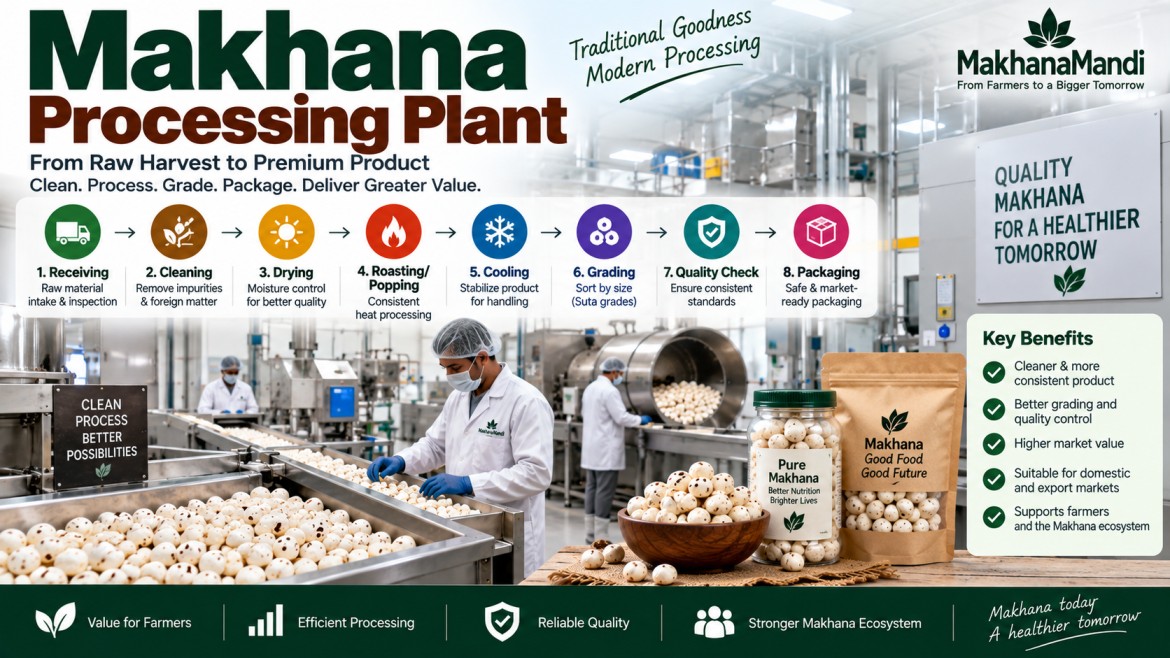
A Makhana processing plant is designed to handle the steps that turn harvested makhana material into a cleaner, more consistent product suitable for commercial use. Processing can involve cleaning, drying, roasting or popping, grading, sorting, quality checks and packaging, depending on the product and facility.
The exact process varies with the raw material, equipment, product specification and intended market. A commercial processing setup should therefore be designed around the required output and quality standard rather than treating every Makhana product as identical.
What happens in a Makhana processing plant?
A processing plant typically organizes several activities into a controlled workflow. The major stages can include receiving raw material, inspection, cleaning, processing, cooling, grading or sorting, quality checking and packing.
Not every facility performs every stage in the same way. Some businesses may receive material that has already undergone part of the processing chain, while others may handle more stages internally.
What you need to know first
Before setting up or evaluating a processing plant, it is important to define the product that the facility is expected to produce. Raw material characteristics, target grade, packaging format, expected throughput and buyer requirements can all affect the equipment and workflow.
Processing should also protect the product from avoidable contamination, excess moisture and unnecessary handling. Cleanable surfaces, appropriate food-contact equipment, organized material movement and suitable storage conditions are important parts of a commercial operation.
Step-by-step Makhana processing
1. Raw material receiving
Incoming material should be received in an organized area where quantity, condition and basic product characteristics can be checked. The receiving process provides an opportunity to identify unsuitable material before it enters the main production workflow.
2. Initial inspection and cleaning
Material can be inspected for visible foreign matter and unsuitable pieces. Cleaning and sorting methods depend on the form of the incoming product and the equipment available at the plant.
The objective is to reduce unwanted material while minimizing unnecessary damage to usable product.
3. Drying and moisture control
Moisture management is an important part of Makhana processing and storage. The appropriate drying approach depends on the incoming material, product specification and process design.
Over-drying, under-drying and uneven drying can all affect subsequent processing and final quality. Commercial operators should therefore establish process controls appropriate to their product rather than relying on an arbitrary universal setting.
4. Roasting or popping
Depending on the raw material and production stage, heat may be used to develop the desired processed Makhana product. Commercial equipment can provide more consistent heat application than small-batch manual processing, but the correct operating conditions depend on the equipment and product.
Uniform processing is important because excessive heat can damage product quality while insufficient processing can produce inconsistent results.
5. Cooling
After a heating stage, the product should be allowed to reach a suitable condition before subsequent handling or packing. Cooling helps reduce the risk of trapping unwanted heat or condensation in packaging.
6. Grading and sorting
Processed Makhana can be separated according to size, appearance or other commercial specifications. Grading helps buyers and sellers communicate more consistently about the product being traded.
In the Makhana trade, Suta-based size descriptions are commonly relevant to commercial listings. Under the MakhanaMandi grading standard, 1 Suta = 3.17 mm. Whole-number grades represent diameter thresholds, while half grades identify intermediate size bands.
7. Quality inspection
Quality inspection should consider the product specification being sold. Depending on the product, checks may include appearance, cleanliness, consistency, moisture-related condition, foreign material and packaging condition.
A processing plant should document its quality checks so that recurring problems can be identified and corrected rather than discovered only after delivery.
8. Packaging
The appropriate packaging depends on the product, intended shelf life, handling conditions and buyer requirements. Packaging should protect the product from moisture, contamination and physical damage during storage and transport.
For commercial trade, packaging information should be communicated clearly so buyers understand whether the product is supplied in bulk or another packaging format.
Equipment used in commercial Makhana processing
The equipment required depends on the stages performed by the facility. A processing operation may use receiving and handling equipment, cleaning or sorting equipment, drying systems, heating or roasting equipment, cooling arrangements, grading systems, weighing equipment and packaging machinery.
Equipment selection should be based on required capacity, product characteristics, available space, cleanability, maintenance requirements, operator safety and the consistency expected by buyers.
How plant layout affects processing
A practical layout should support a logical movement of material from receiving through processing, quality checking and packaging. Unnecessary movement can increase handling and create avoidable opportunities for contamination or product damage.
Separate areas for incoming material, processing, finished product and packaging supplies can make the workflow easier to control. The exact layout should reflect the facility, equipment and applicable food-safety requirements.
Quality considerations in a Makhana processing plant
Consistency
Commercial buyers often need consistent product characteristics from one lot to another. Process controls should therefore be designed to reduce avoidable variation in processing and grading.
Moisture management
Moisture can influence storage stability, texture and packaging performance. It should be considered throughout receiving, processing, cooling, storage and packing.
Foreign material control
Cleaning, sorting and controlled handling can help reduce the risk of unwanted material entering the finished product. Inspection procedures should be practical and repeatable.
Packaging integrity
A good product can still lose quality if its packaging is unsuitable or damaged. Finished packs should therefore be checked for correct sealing, physical condition and suitability for the intended storage and transport conditions.
Common mistakes in Makhana processing
- Designing the plant before defining the target product and capacity.
- Using the same process settings for every type of incoming material.
- Ignoring moisture management after processing.
- Allowing unnecessary movement between processing stages.
- Skipping documented quality checks.
- Choosing packaging without considering storage and transport conditions.
- Assuming that size grade alone defines overall Makhana quality.
Evaluating a Makhana processing plant as a buyer
Buyers evaluating a processor should look beyond a single product photograph or grade label. Useful questions can include how the material is processed, what quality checks are performed, how the product is packed, what quantities can be supplied and whether specifications remain consistent across lots.
Commercial buyers should also compare the actual listing terms, product grade, quantity, packaging and seller information before making a purchasing decision.
Makhana processing and commercial trading
Processing connects agricultural or semi-processed material with products that can be graded, packed and supplied to different markets. The commercial value of a processed product therefore depends not only on processing itself but also on consistency, specifications, packaging, supply capability and buyer requirements.
On MakhanaMandi, marketplace listings can help buyers and sellers communicate product and commercial specifications. Actual listing information should be checked for the specific product and seller rather than assuming that all processing plants or suppliers offer identical products.
Frequently asked questions
How is Makhana processed?
Makhana processing can involve receiving, cleaning, drying or moisture control, roasting or popping, cooling, grading, sorting, quality inspection and packaging. The exact stages depend on the incoming material and the product being produced.
What are the main stages of Makhana processing?
Common stages include raw material inspection, cleaning, moisture management, heat processing where required, cooling, grading or sorting, quality checks and packaging.
What equipment is used in a Makhana processing plant?
Equipment varies by facility but may include cleaning and sorting systems, drying equipment, roasting or heating machinery, cooling arrangements, grading equipment, weighing systems and packaging machinery.
Why is grading important in Makhana processing?
Grading helps separate product according to size or other commercial characteristics. It also helps buyers and sellers communicate more consistently about the product being traded.
Does a larger Makhana grade always mean better quality?
No. Size and overall quality are different characteristics. A larger size may be commercially desirable for some applications, but cleanliness, condition, consistency and other quality factors also matter.
Key takeaway
A Makhana processing plant should be built around a clearly defined product, controlled workflow and measurable quality requirements. Cleaning, moisture management, processing, cooling, grading, inspection and packaging each contribute to the final commercial product. For buyers and businesses, understanding these stages makes it easier to evaluate suppliers and compare Makhana products on their actual specifications.