
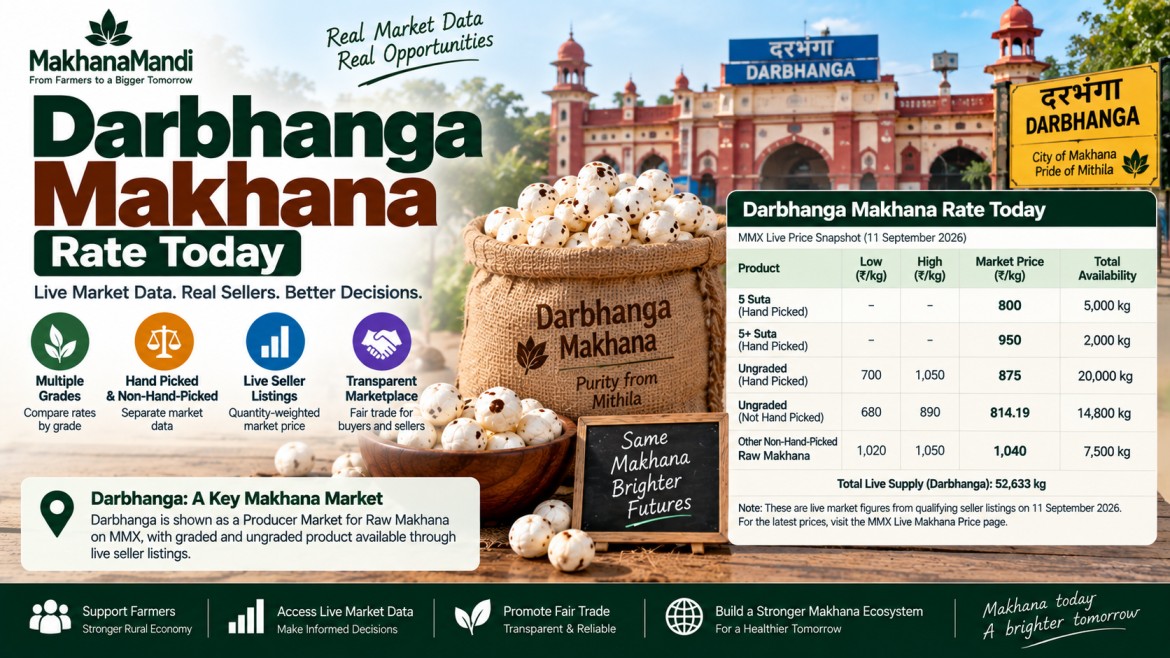
Darbhanga Makhana rate today should be understood as a market signal based on the actual Makhana being offered in the Darbhanga market, its grade, quality characteristics, quantity and commercial terms. MMX uses qualifying live Seller Listings to calculate its live Raw Makhana market data.
Current-data date: 11 September 2026. The figures discussed below are a dated snapshot. For the latest live prices, buyers and sellers should use the MMX Live Makhana Price page, where prices are recalculated from qualifying live Seller Listings.
What is the Darbhanga Makhana rate today?
On the MMX live price board dated 11 September 2026, Darbhanga is shown as a Producer Market for qualifying Raw Makhana listings. The current board includes graded and ungraded product, with prices varying by grade, Hand Picked status and available supply.
The current Darbhanga Producer Market snapshot includes:
- 5 Suta, Hand Picked: ₹800/kg market price, with 5,000 kg shown as total availability.
- 5+ Suta, Hand Picked: ₹950/kg market price, with 2,000 kg shown as total availability.
- Ungraded, Hand Picked: ₹700–₹1,050/kg, with a quantity-weighted market figure of ₹875/kg and 20,000 kg shown as total availability.
- Ungraded, not Hand Picked: ₹680–₹890/kg, with a quantity-weighted market figure of ₹814.19/kg and 14,800 kg shown as total availability.
- Other non-Hand-Picked Raw Makhana shown for Darbhanga: ₹1,020–₹1,050/kg, with a quantity-weighted market figure of ₹1,040/kg and 7,500 kg shown as total availability.
These are live-market figures derived from the listings available when the MMX page was viewed. They are not a universal fixed Darbhanga mandi rate for every Makhana lot.
How MMX calculates the Darbhanga Makhana rate
MMX does not treat a single seller's asking price as the market rate. The live Raw Makhana price is calculated from qualifying live Seller Listings.
The market figure shown inside the MMX price board is a quantity-weighted live seller price. The displayed Low and High values represent the lowest and highest qualifying seller prices for that market segment.
This approach helps distinguish between a single quoted price and a market signal based on multiple qualifying offers.
Why Darbhanga is shown as the market location
For Raw Makhana, MMX assigns the market according to the Seller Business District, not the Product Origin District.
This distinction matters because Makhana can originate in one location and be offered for sale by a business operating in another. Using the seller's business district makes the market classification consistent with where the commercial offer is being made.
Why Darbhanga Makhana rates vary
There is rarely one meaningful price for every Makhana lot. Rates can differ because of product characteristics and commercial conditions.
Grade and size
Makhana grade can influence commercial pricing. Different buyers may have different requirements for size and consistency. Under the MakhanaMandi grading standard, 1 Suta = 3.17 mm, with whole-number grades representing diameter thresholds and half grades representing intermediate size bands.
Hand Picked status
The MMX live board separates Hand Picked and non-Hand-Picked product where applicable. This distinction can contribute to different market prices and should be checked when comparing offers.
Quantity
Commercial quantity matters because the economics of a small lot and a large bulk transaction can differ. MMX therefore displays available supply alongside market prices.
Product condition and quality
Cleanliness, consistency, processing condition, grade and other quality characteristics can affect what a buyer is willing to pay. A rate should therefore always be interpreted together with the actual product specification.
Buyer and seller requirements
Packaging, minimum order quantity, delivery requirements, payment terms and other commercial conditions can also influence the effective value of an offer.
Darbhanga rate versus one seller's price
A seller listing price and a market price are not necessarily the same thing. A seller may quote a particular price for a particular grade, quality, quantity or commercial arrangement.
MMX's market figure is designed as a market signal derived from qualifying live seller listings. It should not be interpreted as a guaranteed transaction price or as a fixed mandi rate applicable to every seller.
How buyers should read the Darbhanga rate
Buyers should compare the price with the exact product specification before deciding that one offer is cheaper or more expensive.
A practical comparison should include:
- Grade or size
- Hand Picked status
- Quantity available
- Price per applicable unit
- Packaging
- Minimum order quantity
- Product condition and quality information
- Seller business location
- Delivery and other commercial terms
Comparing only the headline ₹/kg figure can produce a misleading conclusion when the underlying products are different.
How sellers can interpret the Darbhanga market
Sellers can use market data as a reference point when evaluating their own offers, but should not assume that the displayed market figure is automatically the correct price for every lot.
A seller's actual commercial opportunity depends on the product grade, quality, quantity, buyer requirements and other transaction terms. Keeping listing information accurate makes market comparisons more useful for everyone.
Darbhanga Makhana rate and live market supply
The MMX live board dated 11 September 2026 showed multiple Raw Makhana listings across its Producer Markets, with Darbhanga contributing several graded and ungraded offers. The price board showed total live Raw Makhana supply of 52,633 kg across the displayed live listings.
Supply can change as listings are added, updated, closed or otherwise cease to qualify. For that reason, today's rate should not be treated as tomorrow's rate.
Darbhanga Makhana rate today versus historical prices
A current rate answers a different question from a historical price series. The MMX live price page currently provides live market figures and is designed to support future historical price tracking through immutable daily snapshots.
As of 11 September 2026, the MMX page states that no historical Raw Makhana price snapshots are available yet. Therefore, a historical trend should not be inferred from today's live figure alone.
Where to check the latest Darbhanga Makhana price
Because live seller listings can change, the best place to check the latest MMX market signal is the Live Makhana Price page.
Buyers can also review the underlying live listings and compare the actual product specifications instead of relying only on an aggregate market figure.
Frequently asked questions
What is the Darbhanga Makhana rate today?
MMX's Darbhanga Raw Makhana rates vary by grade, Hand Picked status and listing characteristics. On the 11 September 2026 snapshot, examples included ₹800/kg for 5 Suta Hand Picked and ₹950/kg for 5+ Suta Hand Picked. Ungraded Hand Picked product showed ₹700–₹1,050/kg with a quantity-weighted market figure of ₹875/kg.
Is Darbhanga Makhana rate fixed?
No. Makhana prices can change as qualifying seller listings change. The MMX live price is a market signal rather than a guaranteed fixed transaction price.
How does MMX calculate the Darbhanga Makhana price?
MMX uses qualifying live Seller Listings. For Raw Makhana, the market is assigned to the Seller Business District, and the market figure is calculated as a quantity-weighted average. Low and High represent the lowest and highest qualifying seller prices.
Does Makhana grade affect the Darbhanga rate?
Yes. Different grades can have different market prices because buyers may value size and consistency differently. The actual product specification should always be checked alongside the price.
Is the MMX Darbhanga rate the same as every seller's price?
No. Individual sellers may quote different prices based on grade, quality, quantity, packaging and commercial terms. The MMX market figure is an aggregate market signal from qualifying listings.
Where can I check the latest Darbhanga Makhana rate?
Use the MMX Live Makhana Price page for the latest available live market data and then review the underlying listings for specific commercial offers.
Key takeaway
The Darbhanga Makhana rate today is best understood as a live market signal rather than one fixed price. Grade, Hand Picked status, supply, quality and commercial terms all matter. MMX calculates its Raw Makhana market figure from qualifying live Seller Listings using a quantity-weighted approach and assigns the market to the Seller Business District. Because live listings change, buyers and sellers should always check the latest MMX data and the actual listing specifications before making a trade decision.