
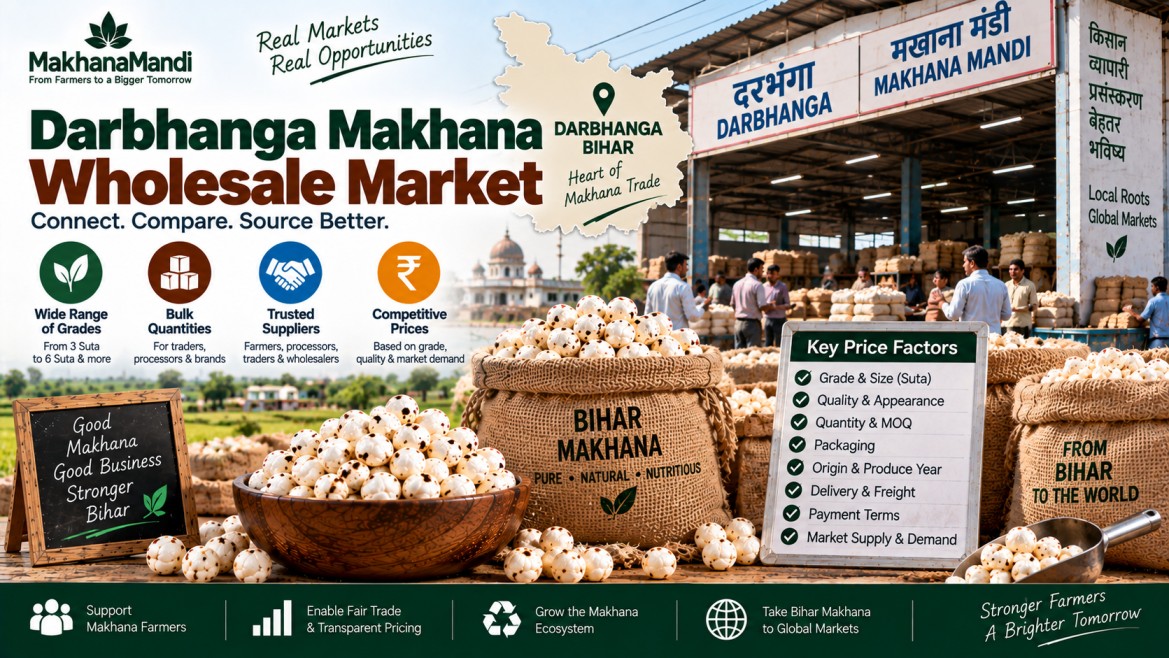
The Darbhanga Makhana wholesale market is an important part of the commercial Makhana ecosystem in Bihar. Darbhanga connects producers, processors, traders, aggregators and buyers across the regional supply chain, making it relevant for businesses sourcing Makhana in commercial quantities.
Wholesale Makhana prices in Darbhanga are not represented by one fixed market rate. The price depends on grade, quality, processing condition, quantity, packaging, origin, delivery terms and current supply and demand.
This guide explains how buyers should evaluate the Darbhanga Makhana wholesale market, how wholesale prices are determined, what information should be included in a buying requirement and how businesses can compare available offers more effectively.
Why is Darbhanga important for the Makhana trade?
Darbhanga is part of the Makhana-producing and trading region of Bihar and has an established network of businesses involved in agricultural sourcing, processing and trade.
The commercial ecosystem includes farmers and raw-material suppliers, processors, wholesalers, traders, distributors and buyers. This creates opportunities for businesses to source different grades and quantities according to their requirements.
For a wholesale buyer, the importance of a market is not simply its location. The availability of suitable grades, reliable suppliers, commercial quantities and transparent specifications is equally important.
Is there one wholesale price for Makhana in Darbhanga?
No. There is no single wholesale price that applies to every Makhana lot.
A quotation for one grade should not be directly compared with a quotation for another grade without checking the underlying specification.
Important price variables include:
- Makhana grade and size
- Quality and appearance
- Processing condition
- Quantity available
- Minimum order quantity
- Packaging
- Origin
- Production or harvest year where relevant
- Delivery location
- Freight and other commercial terms
- Payment terms
- Current market supply and demand
What grades are traded in the Darbhanga market?
Commercial Makhana is commonly differentiated by size grades, with Suta used as a grading reference in the trade.
Different buyers may require different grades depending on their intended application. Premium retail products may prefer larger and visually attractive pieces, while processors and other commercial buyers may purchase other grades according to their product specifications.
Buyers should specify the required grade clearly rather than asking only for “Makhana” or “good-quality Makhana.”
Darbhanga Makhana wholesale price factors
Wholesale prices can move as market conditions change. A useful way to understand a quotation is to separate the intrinsic product factors from logistics and commercial factors.
Grade and size
Size is one of the most visible commercial characteristics. Larger or specifically graded Makhana can command different prices from smaller or mixed material.
Quality
Colour, cleanliness, breakage, uniformity, moisture condition and processing consistency can affect the value of a lot.
Quantity
Wholesale transactions involve commercial quantities, and the quantity requested can affect the price offered by a supplier.
Packaging
Packaging affects handling, protection and logistics. Bulk commercial packaging and consumer-oriented packaging have different cost structures.
Delivery and freight
A Darbhanga-origin price is not necessarily the same as the buyer's delivered cost. Freight, loading, handling and destination-related costs should be considered separately when comparing offers.
How to compare Makhana wholesale quotations in Darbhanga
Buyers should normalize quotations before deciding which offer is cheaper.
For example, two suppliers may quote different prices because one is offering a different Suta grade, different packaging, a different quantity or a different delivery basis.
A practical comparison should record:
- Supplier
- Product
- Grade
- Quality specification
- Quantity
- MOQ
- Unit price
- Packaging
- Origin
- Delivery location
- Freight terms
- Payment terms
- Availability period
Only after these variables are aligned does a price comparison become meaningful.
Buying Makhana wholesale from Darbhanga
A wholesale buyer should start with a precise purchase requirement.
A useful requirement can specify the desired grade, quantity, packaging, delivery location, acceptable quality parameters and commercial terms. This allows suppliers to respond with comparable quotations.
For larger purchases, buyers should also consider sample evaluation and confirmation of the agreed specification before dispatch.
What should buyers check before purchasing?
Price is important, but it should not be the only consideration in a wholesale Makhana transaction.
- Business identity and contact information
- Product and grade specification
- Actual available quantity
- Quality consistency
- Packaging condition
- Origin information
- Production or harvest year where relevant
- MOQ
- Delivery capability
- Payment terms
- Relevant verification or business credentials
For significant transactions, buyers should perform appropriate commercial due diligence and confirm the final specification in writing.
Darbhanga market for raw and processed Makhana
The Makhana supply chain includes both raw material and processed products. These should not be treated as interchangeable when comparing prices.
Raw or ungraded material can have a different commercial value and processing requirement from finished Phool Makhana. Similarly, roasted, flavoured or packaged Makhana may include additional processing, packaging and branding costs.
Buyers should therefore identify the exact product form before requesting a wholesale quotation.
How seasonality affects the Makhana market
Agricultural supply conditions can influence the availability and pricing of Makhana. Harvest timing, inventory levels, processing capacity and demand can all affect market conditions.
Because of these variables, a historical price should not automatically be treated as the current wholesale price. Buyers should check current offers when making a purchasing decision.
Darbhanga Makhana market and logistics
For buyers outside Darbhanga, the relevant commercial number is often the delivered cost rather than the supplier's quoted origin price.
Businesses should compare the product price together with packaging, loading, freight, insurance where applicable and other logistics costs.
The final delivered economics can make a slightly higher origin quotation more attractive if it includes better packaging, more suitable logistics or clearer commercial terms.
How businesses can source Makhana through MakhanaMandi
Businesses looking for current Makhana supply can use the MakhanaMandi marketplace to review available listings and business information.
The Makhana listings section can be used to discover current offers, while the business directory provides another way to identify participating businesses.
For current market signals, buyers can also review the Live Makhana Price page. Individual trade listings should be treated as time-sensitive offers rather than permanent market references.
Darbhanga Makhana wholesale market for exporters
Export-oriented buyers and processors may source Makhana from the Darbhanga region as part of their broader procurement strategy.
Export procurement requires additional attention to product specifications, food compliance, packaging, documentation, destination-country requirements and logistics. A product that is suitable for domestic wholesale trade may require additional preparation for a particular export market.
Export buyers should therefore establish the final destination and product specification before confirming procurement.
How suppliers can improve their wholesale offers
Suppliers can make their offers easier for buyers to evaluate by providing complete commercial information.
- Exact product name
- Grade or Suta specification
- Quality details
- Available quantity
- MOQ
- Price and unit
- Packaging type
- Origin
- Production or harvest year where relevant
- Delivery terms
- Payment terms
- Availability period
Clear specifications reduce unnecessary negotiation and make it easier for serious wholesale buyers to compare suppliers.
Common mistakes when buying wholesale Makhana
Comparing different grades as if they were identical
A price comparison is unreliable when the grades or specifications are different.
Ignoring MOQ
A low unit price may not be useful if the supplier's minimum order quantity is substantially higher than the buyer's requirement.
Ignoring delivered cost
The origin price does not always represent the buyer's final procurement cost.
Buying only on price
Quality consistency, supplier reliability, packaging and commercial terms can materially affect the value of a transaction.
Using an old market rate as a current quote
Makhana prices can change with supply, demand and product availability. Current offers should be checked before placing an order.
Frequently asked questions
What is the Darbhanga Makhana wholesale market?
It refers to the network of businesses and commercial trading activity through which Makhana is sourced, processed, sold and distributed in and around Darbhanga.
What is the current wholesale price of Makhana in Darbhanga?
There is no single price for all Makhana. Current prices vary according to grade, quality, quantity, packaging, origin and commercial terms. Buyers should check current listings and supplier quotations for the exact specification they need.
Which Makhana grades are available in Darbhanga?
Availability varies by supplier and market conditions. Commercial Makhana is commonly differentiated by size grades, including Suta-based specifications.
How can I buy Makhana wholesale from Darbhanga?
Define the required grade, quantity, quality, packaging and delivery terms, then compare current supplier offers. Buyers should confirm the final specification and commercial terms before ordering.
Is Darbhanga suitable for bulk Makhana sourcing?
Darbhanga is part of the Bihar Makhana ecosystem and can be relevant for commercial sourcing. Suitability depends on the buyer's required grade, quantity, quality, logistics and supplier requirements.
Can Makhana from Darbhanga be exported?
Makhana sourced from the region can enter export supply chains, but exporters must satisfy the requirements applicable to the exact product and destination market.
Conclusion
The Darbhanga Makhana wholesale market should be understood as a dynamic commercial ecosystem rather than a single fixed-price market. Grade, quality, quantity, packaging, logistics and commercial terms all influence the final value of a transaction.
For buyers, the best approach is to define the product specification clearly, compare like-for-like quotations and verify the supplier before committing to a significant purchase. For suppliers, transparent specifications and complete commercial information make it easier to attract serious wholesale buyers.