
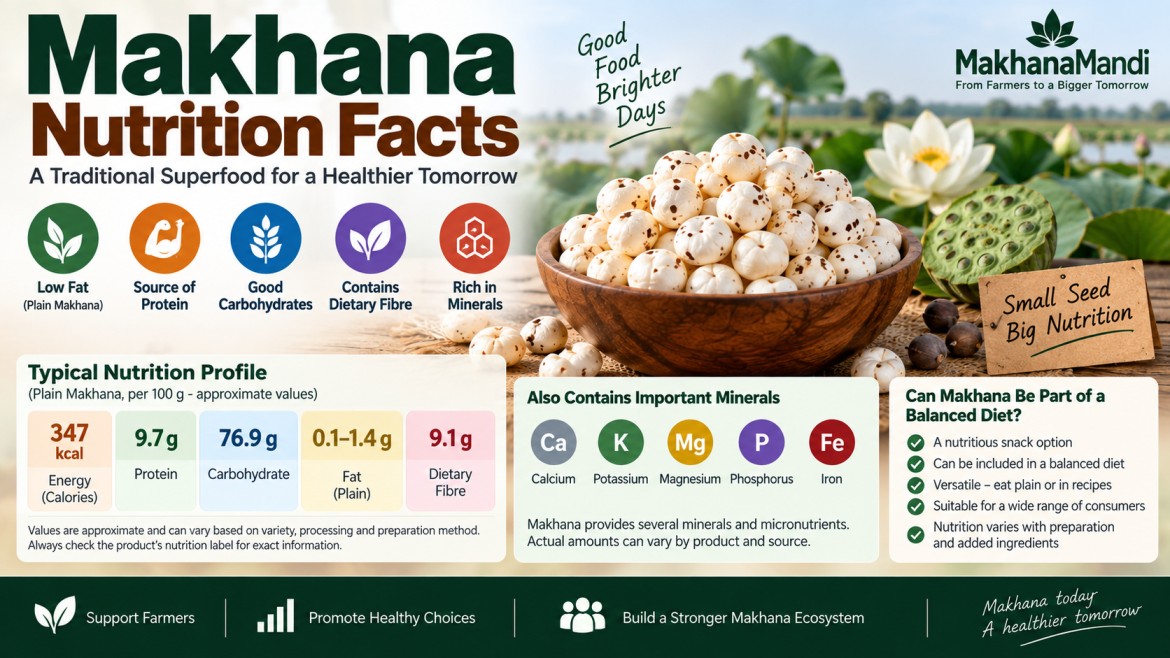
Makhana nutrition facts are useful for consumers, food businesses and buyers who want to understand what this traditional fox nut product contributes to a balanced diet. Makhana is commonly eaten roasted, as a snack, or incorporated into recipes. Its nutritional profile can vary depending on the product, processing, roasting method and any ingredients added during preparation.
What is Makhana?
Makhana is the edible seed of the Euryale ferox plant and is widely associated with the wetland regions of Bihar and the wider Mithila region. After harvesting and processing, the seeds are commonly sold as popped Makhana and used as a snack or cooking ingredient.
For nutrition purposes, it is important to distinguish plain Makhana from prepared products. Plain or lightly processed Makhana can have a different nutritional profile from products roasted with oil, sugar, salt, spices or other ingredients.
Makhana nutrition: what does it provide?
Makhana provides carbohydrate, protein and small amounts of fat, along with minerals and other nutrients. The exact amounts depend on the product and preparation method, so nutrition labels or laboratory-tested product specifications should be used when precise values are required.
For consumers comparing products, the most useful information to check includes calories, protein, carbohydrate, total fat, dietary fibre where declared, and relevant minerals. A packaged product should be assessed using its own nutrition declaration rather than assuming that every Makhana product has identical values.
How many calories are in Makhana?
The calorie content of Makhana depends on the serving size and whether it is plain or prepared with additional ingredients. Plain Makhana should therefore be considered separately from roasted snack products containing oil, sugar or other additions.
When comparing calorie intake, check the serving size on the product label. A serving-based comparison is more meaningful than comparing numbers from products with different serving definitions.
How much protein does Makhana provide?
Makhana contains protein, but the amount should be interpreted in the context of the complete diet. Protein values can vary between products and preparation methods, so buyers looking for a precise specification should refer to the manufacturer's nutrition declaration or laboratory analysis.
Makhana can contribute to daily protein intake, but it should not automatically be described as a high-protein replacement for foods that are specifically concentrated sources of protein.
Makhana carbohydrates, fat and fibre
Makhana contains carbohydrates and relatively modest amounts of fat in its plain form. Preparation can substantially change the overall nutritional profile. For example, adding cooking oil increases the fat and energy content of the finished snack.
Dietary fibre values should also be taken from the relevant product specification because processing and analytical methods can affect the declared value.
Makhana minerals and micronutrients
Makhana contains several minerals and other micronutrients, but the amount present in a particular product can vary. Soil, cultivation conditions, processing, storage and preparation can all influence the final food product.
For commercial or regulatory purposes, nutrient claims should be supported by appropriate laboratory testing and the applicable food-labelling requirements rather than relying on generic online nutrition tables.
Is Makhana a healthy food?
Makhana can fit into a balanced eating pattern, particularly when consumed in an appropriate portion and prepared without excessive additions. However, calling a food simply “healthy” does not provide enough information on its own. Overall dietary pattern, portion size, preparation method and individual nutritional needs all matter.
Plain Makhana and a heavily seasoned or oil-roasted Makhana snack should not be treated as nutritionally identical. The ingredients added during preparation can change calories, sodium, fat and other nutritional characteristics.
How does Makhana compare with almonds nutritionally?
Makhana and almonds are different foods and should not be treated as direct nutritional substitutes. Almonds are a tree nut with a different macronutrient profile, while Makhana is a seed that is commonly consumed after popping.
If comparing them, consider the specific nutritional objective. Protein, calories, fat, carbohydrates, fibre and micronutrients can all differ, and the comparison should use equivalent serving sizes and comparable preparation methods.
How can Makhana fit into a balanced diet?
Makhana can be used as a snack or incorporated into meals. A balanced approach is to combine it with a varied diet containing appropriate sources of protein, vegetables or fruit, whole grains or other carbohydrate sources, and sources of healthy fats as appropriate to individual dietary needs.
Portion size matters. A plain Makhana snack may have a different nutritional profile from one prepared with substantial oil, sugar or salty seasonings.
What should buyers check on a Makhana nutrition label?
When buying packaged Makhana, check the nutrition information together with the ingredient list and serving size. Useful points to compare include:
- Calories or energy per serving and per 100 g where provided.
- Protein content.
- Carbohydrate content.
- Total fat.
- Dietary fibre where declared.
- Sodium or salt, particularly for seasoned products.
- Added ingredients such as oil, sugar, flavourings or seasonings.
- Serving size and the number of servings in the package.
Does roasting change Makhana nutrition?
Roasting itself should be distinguished from the ingredients used during roasting. Dry roasting and roasting with oil can produce different finished products. Similarly, adding sugar, salt, spices or other ingredients changes the overall nutritional profile.
For commercial products, the nutrition declaration should represent the product actually being sold, rather than an assumption based on plain Makhana.
Nutrition facts for Makhana used in commercial food products
Food manufacturers, processors and buyers may require more detailed information than a consumer nutrition label provides. Depending on the application, this can include laboratory-tested nutrient values, ingredient specifications, moisture information, allergen declarations and other quality or compliance documentation.
For B2B purchasing, the specification should be linked to the actual product lot or product formulation whenever precise nutritional characteristics are commercially important.
Frequently asked questions about Makhana nutrition
Is Makhana high in protein?
Makhana contains protein, but it should not automatically be classified as a high-protein food without considering the serving size and the applicable nutritional criteria. Use the product's nutrition declaration or laboratory analysis for precise values.
Is Makhana high in calories?
The calorie content depends on serving size and preparation. Plain Makhana should be distinguished from Makhana roasted with oil, sugar or other ingredients.
Can Makhana be part of a balanced diet?
Yes. Makhana can be included as part of a varied and balanced diet. Portion size and preparation method are important when assessing its overall nutritional contribution.
Is Makhana better than almonds?
Neither is universally “better.” They have different nutritional profiles and can serve different roles in a diet. A meaningful comparison should use equivalent serving sizes and the specific nutritional criteria that matter to the consumer.
Where can I check current Makhana products and commercial listings?
For buyers and businesses, MakhanaMandi provides marketplace listings that can be used to explore available Makhana products and commercial supply. Product specifications should always be confirmed with the seller for the specific lot or offering.
Key takeaway
Makhana can be a useful food to include in a varied diet, but its nutritional profile should be evaluated based on the actual product and preparation method. For accurate Makhana nutrition facts, use the product's nutrition declaration or appropriate laboratory-tested specification, especially when making commercial, regulatory or health-related claims.