
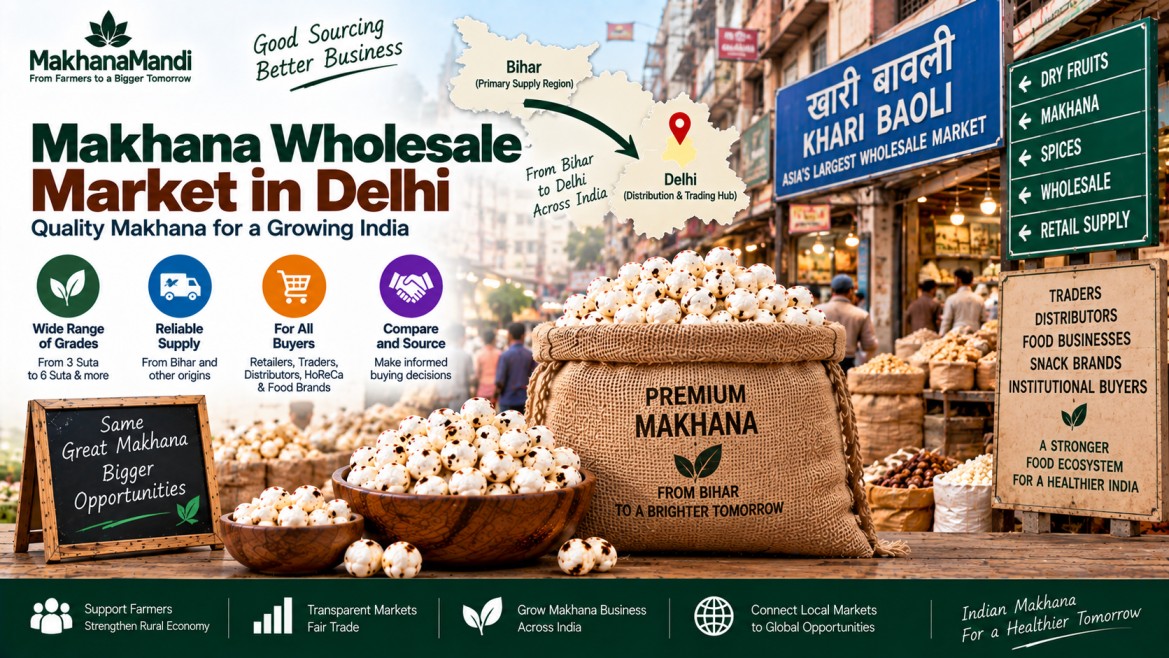
Delhi is an important destination market for Makhana, serving retailers, dry-fruit traders, food businesses, distributors, snack brands, HoReCa buyers and other bulk purchasers. For buyers searching for the Makhana wholesale market in Delhi, the most important point is that Delhi is primarily a consumption, distribution and trading centre rather than the main production origin. Much of the commercial supply entering Delhi is sourced from Bihar and other producing regions.
This makes price comparison more complicated than simply checking one mandi quotation. Grade, origin, size, quality, moisture, processing, packaging, order quantity, delivery location and commercial terms can all change the final buying price.
What is the Makhana wholesale market in Delhi?
The Makhana wholesale market in Delhi is better understood as a network of wholesale and distribution channels rather than a single dedicated Makhana mandi. Delhi buyers can source Makhana through traditional dry-fruit and wholesale markets, specialist Makhana suppliers, distributors, processors, private-label businesses and direct-origin supply relationships.
Khari Baoli and other established wholesale trading areas are relevant to Delhi's dry-fruit trade, while suppliers operating from different parts of Delhi NCR may also serve retailers, food businesses and institutional buyers.
For a buyer, the practical question is therefore not only where to buy, but also whether the quoted material has the required grade, consistency, origin, packaging and commercial terms.
Is there one fixed Makhana wholesale rate in Delhi?
No. There is no single wholesale rate that applies to every Makhana transaction in Delhi.
A wholesale quotation can differ substantially depending on the grade and specification. A buyer comparing a 4 Suta product with a 6 Suta product, for example, is not necessarily comparing equivalent merchandise. The same applies when one quotation is for bulk raw Makhana and another is for cleaned, processed, branded or retail-ready material.
For this reason, a useful Delhi wholesale comparison should record at least:
- Makhana grade or Suta
- Raw, processed or roasted form
- Quantity available
- Minimum order quantity
- Origin
- Packaging
- Produce year where relevant
- Price unit, such as ₹/kg
- Delivery location and freight terms
- Payment terms
MMX market data: current Makhana price benchmarks
MakhanaMandi's live marketplace data can provide a useful first-party reference point for buyers, but it should not be misrepresented as a Delhi mandi quotation. The currently available live seller listings reviewed for this article are primarily from Bihar origins, including Darbhanga and Purnea.
As of 11 September 2026, examples in the live MMX marketplace include:
| Grade / Product | Origin | Listed price | Quantity | MOQ |
|---|---|---|---|---|
| 4 Suta Makhana | Darbhanga, Bihar | ₹600/kg | 500 kg | 100 kg |
| 5 Suta Makhana | Darbhanga, Bihar | ₹800/kg | 5,000 kg | Not specified |
| 5.5 Suta Makhana | Darbhanga, Bihar | ₹950/kg | 2,000 kg | 500 kg |
| 6 Suta Makhana | Darbhanga, Bihar | ₹1,050/kg | 3,000 kg | 500 kg |
| 6 Suta Makhana | Purnea, Bihar | ₹1,050/kg | 5,000 kg | 1,000 kg |
| 6 Suta Makhana | Purnia, Bihar | ₹1,133/kg | 3,333 kg | 333 kg |
These are live MMX listing prices from the stated origins, not Delhi market rates. A Delhi buyer should therefore use them as origin-market benchmarks and then compare the delivered Delhi quotation after freight, handling, packaging and other commercial costs.
What affects Makhana wholesale prices in Delhi?
1. Suta or size grade
Size is one of the most important commercial variables. Larger and more uniform Makhana can command a different price from smaller grades. Buyers should always confirm the grading basis rather than comparing descriptions such as “premium” or “large” without a measurable specification.
2. Quality and appearance
Uniformity, colour, cleanliness, breakage, popping quality and overall physical condition influence commercial value. A low headline price may not represent better value if the lot has inconsistent quality or excessive broken material.
3. Moisture and storage condition
Makhana is a low-moisture product, but moisture control remains important for maintaining quality during storage and transportation. Buyers should establish acceptable specifications and inspect samples where the transaction size justifies it.
4. Origin and supply chain
Delhi buyers frequently source from producing regions rather than from farms within Delhi. Bihar is a major Makhana-producing region, so the commercial comparison may involve an origin price plus logistics and trading costs before the product reaches a Delhi warehouse or buyer.
5. Order quantity and MOQ
A quotation for 50 kg should not automatically be compared with a quotation for several tonnes. Larger orders can have different commercial terms, while smaller buyers may pay more per kilogram because of handling, packaging and distribution costs.
6. Packaging and processing
Bulk bags, processed Makhana, roasted products, branded packs and private-label requirements represent different commercial products. Packaging and processing costs should be separated from the underlying Makhana commodity price when making a comparison.
7. Freight and delivery terms
A Delhi buyer should compare the delivered cost, not only the ex-origin price. Freight, unloading, local transport, insurance where applicable and other handling costs can affect the final landed price.
Where do Delhi buyers source Makhana?
Delhi buyers can use several sourcing channels depending on their requirement:
- Traditional dry-fruit and wholesale trading markets
- Specialist Makhana wholesalers and distributors
- Direct suppliers connected with Bihar production centres
- Processors and private-label manufacturers
- Online B2B marketplaces
- Direct business-to-business listings and supplier networks
For larger transactions, buyers should compare multiple offers using the same specification. A structured marketplace can make this easier because grade, quantity, MOQ, origin and commercial details can be compared before contacting the seller.
How should a Delhi buyer compare two Makhana quotations?
Suppose one supplier quotes ₹900/kg and another quotes ₹950/kg. The lower quotation is not automatically the better deal.
Before deciding, compare:
- Exact Suta or grade
- Quantity available
- MOQ
- Origin
- Quality specifications
- Produce year where relevant
- Packaging
- Whether the price includes processing or branding
- Freight and delivery terms
- Payment terms
The correct comparison is the landed cost for equivalent material, not simply the lowest number displayed in a quotation.
Delhi Makhana wholesale market vs buying directly from Bihar
Delhi sourcing can be convenient because the buyer may have easier access to local stock, inspection, warehousing and delivery. Direct-origin purchasing can sometimes provide access to larger quantities and closer-to-source pricing, but it also requires the buyer to manage logistics, quality verification and supplier due diligence.
Neither route is automatically better. The right choice depends on order size, working capital, delivery requirements, quality specifications and the buyer's ability to manage procurement.
What should wholesale buyers check before placing an order?
- Verify the seller's business identity and contact details.
- Ask for the exact grade and specification.
- Request a representative sample for significant purchases.
- Confirm quantity and MOQ in writing.
- Confirm whether the quoted price is ex-origin or delivered.
- Check packaging and net weight.
- Confirm payment and dispatch terms.
- For repeat procurement, record lot and quality information for future comparison.
Buyers should also avoid treating an old quotation as a current market rate. Makhana prices can change with availability, grade demand, crop conditions, procurement activity and order size.
How MakhanaMandi can help Delhi buyers
MakhanaMandi is designed to bring Makhana businesses, sellers, buyers and marketplace information into one business-focused ecosystem. Instead of relying only on an informal price quote, buyers can use marketplace information to compare available listings and understand the commercial specification behind an offer.
For Delhi buyers, the most useful approach is to search for the required grade, quantity and origin, compare multiple sellers, and then verify the commercial terms directly before placing an order.
MMX live listing data should always be read with its stated date, origin, quantity and other listing conditions. Individual trade listings can change or expire, so buyers should use the current marketplace rather than relying on an old listing URL.
Frequently asked questions
What is the Makhana wholesale market in Delhi?
It is a network of wholesale, trading, distribution and specialist supplier channels through which Delhi and Delhi NCR buyers source Makhana. It is not limited to one dedicated Makhana-only mandi.
What is the wholesale price of Makhana in Delhi?
There is no single fixed Delhi wholesale price. The price depends on grade, quality, quantity, origin, packaging, processing and delivery terms. Current MMX listings can be used as a first-party benchmark, but Bihar-origin listing prices should not be presented as Delhi mandi prices.
Where can I buy Makhana wholesale in Delhi?
Buyers can source through traditional wholesale markets, specialist Makhana suppliers, distributors, processors and B2B marketplace channels. For commercial purchases, compare equivalent grades and specifications before selecting a supplier.
Is Khari Baoli a Makhana wholesale market?
Khari Baoli is an important Delhi wholesale trading area associated with dry fruits and related commodities, and Makhana is traded through Delhi's broader wholesale network. Buyers should still verify the exact supplier, grade and current quotation rather than assuming that every seller offers the same Makhana specification.
Should Delhi buyers purchase Makhana directly from Bihar?
Direct-origin procurement can be useful for larger buyers, but it should be evaluated against logistics, quality verification, MOQ, payment terms and delivered cost. Local Delhi procurement may be preferable when faster delivery or smaller quantities are more important.
How can I compare Makhana wholesale prices accurately?
Compare equivalent Suta or grade, quantity, quality, origin, packaging, processing, MOQ, freight and payment terms. The most useful figure is the delivered cost for equivalent material rather than the headline quotation alone.
Bottom line
The Makhana wholesale market in Delhi is best understood as a connected trading and distribution ecosystem supplied substantially by producing regions such as Bihar. Delhi buyers should avoid relying on a single generic “Makhana rate” and instead compare grade, quality, quantity, origin and delivered cost.
For current procurement decisions, MakhanaMandi's live marketplace can provide a useful first-party reference point. As the marketplace grows, more location-specific listings can make Delhi price discovery increasingly transparent for buyers and sellers.