
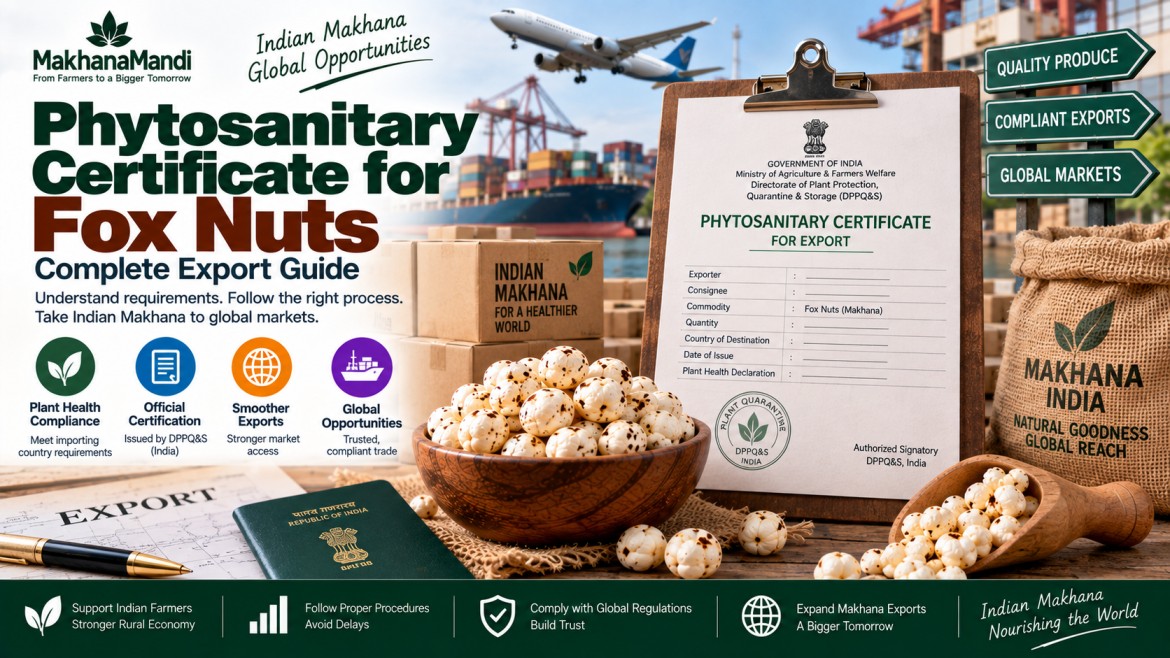
A phytosanitary certificate for Fox Nuts may be required when exporting Makhana from India, depending on the importing country's plant-health requirements and the specific product and consignment. Exporters should never assume that every Fox Nuts shipment automatically requires a phytosanitary certificate or that every destination follows the same procedure.
In India, phytosanitary certification is part of the country's plant-quarantine system. The Directorate of Plant Protection, Quarantine & Storage (DPPQ&S) undertakes phytosanitary certification and supports agricultural export market access from the phytosanitary perspective. :contentReference[oaicite:1]{index=1}
This guide explains what a phytosanitary certificate is, when it may become relevant to Fox Nuts exports, how exporters should approach the certification process and which points should be verified before shipment.
What is a phytosanitary certificate?
A phytosanitary certificate is an official plant-health certificate issued by the competent authority of the exporting country for consignments where phytosanitary certification is required. Its purpose is to provide the importing country's authorities with the required assurance regarding the plant-health status of the exported consignment.
India's plant-quarantine system describes phytosanitary certification as one of its functions and supports safe international agricultural trade through the phytosanitary certification system. :contentReference[oaicite:2]{index=2}
Do Fox Nuts exports require a phytosanitary certificate?
Not necessarily for every shipment.
The requirement depends on the importing country's regulations, the commodity classification, the form of the product and any specific phytosanitary conditions attached to the import.
An exporter should therefore establish the requirement for the exact destination and product before accepting an order or preparing a shipment.
The correct question is not simply “Do Fox Nuts need a phytosanitary certificate?” but rather:
- What is the exact Fox Nuts/Makhana product?
- What is the destination country?
- How does the destination country classify the product?
- Does the importing authority require a phytosanitary certificate?
- Are there additional declarations or treatment requirements?
- Is an import permit required?
- Are there commodity-specific conditions?
Who issues phytosanitary certificates in India?
Phytosanitary certification is administered through India's plant-quarantine framework under the Directorate of Plant Protection, Quarantine & Storage. Authorized officers undertake phytosanitary certification for export consignments. :contentReference[oaicite:3]{index=3}
Exporters should use the current official Plant Quarantine procedures and designated authorities applicable to their shipment rather than relying on an old checklist or an unofficial intermediary.
Why destination-country requirements matter
Phytosanitary requirements are fundamentally connected to the plant-health rules of the importing country.
A destination country may impose requirements relating to quarantine pests, treatment, inspection, additional declarations, import permits or other plant-health conditions. These requirements can differ between countries and can also differ according to the commodity and intended use.
APEDA's export resources publish destination- and commodity-specific export procedures and SPS information, illustrating why exporters should verify requirements for the exact market rather than apply one universal export checklist. :contentReference[oaicite:4]{index=4}
Phytosanitary certificate vs food-safety certificate
A phytosanitary certificate and a food-safety certificate are not automatically interchangeable.
A phytosanitary certificate addresses plant-health or quarantine requirements. Food-safety compliance can involve separate requirements concerning contaminants, residues, microbiological standards, ingredients, additives, labelling and other characteristics of the food product.
An exporter may therefore need to satisfy both plant-health and food-related requirements when applicable to a particular destination and product.
Phytosanitary certificate vs fumigation certificate
These documents should also not be treated as identical.
Fumigation or other treatment documentation may be required in particular circumstances, while the phytosanitary certificate is the official plant-health certification document. Whether treatment is required depends on the destination country's conditions and the specific consignment.
India's plant-quarantine framework separately includes fumigation, disinfestation and disinfection activities alongside phytosanitary certification. :contentReference[oaicite:5]{index=5}
What should an exporter check before applying?
Before starting the certification process, an exporter should establish the complete import requirement for the destination market.
- Exact product description
- Product form and processing status
- Destination country
- Destination port or entry point where relevant
- Import permit requirement
- Phytosanitary certificate requirement
- Required additional declarations
- Required treatment, inspection or testing
- Packaging requirements
- Labelling requirements
- Any buyer-specific documentation
Getting these requirements confirmed before shipment reduces the risk of preparing an incomplete or unsuitable consignment.
What information may be needed for phytosanitary certification?
The precise information and supporting documents depend on the applicable procedure and destination-country conditions.
An exporter should be prepared to provide accurate shipment information, which may include:
- Exporter details
- Consignee or importer details
- Commodity description
- Quantity and packaging
- Country of origin
- Destination country
- Transport or shipment information
- Applicable import permit information
- Required declarations or treatment information
- Other documents requested by the competent authority
Exporters should use the current official application and certification requirements for their particular shipment rather than relying on a fixed historical document list.
Inspection and phytosanitary certification
Where phytosanitary certification is required, the competent plant-quarantine authority may need to inspect the consignment or verify compliance with the relevant plant-health conditions before issuing the certificate.
The purpose is to establish whether the consignment meets the applicable phytosanitary requirements of the importing country.
Because inspection and certification procedures can vary according to commodity, destination and treatment conditions, exporters should follow the current instructions issued by the relevant plant-quarantine authority.
Additional declarations and import permits
Some importing countries may specify additional declarations that must appear on the phytosanitary certificate. Others may require an import permit or impose particular treatment or inspection conditions before allowing the commodity into the country.
These requirements are destination-specific. An exporter should obtain the applicable import requirements before preparing the shipment and communicate the requirements accurately to the Indian certification authority.
Can a processed food product have different requirements?
Yes. The form and processing level of the product can affect how the importing country treats it for plant-health purposes.
Plain popped Makhana, roasted Makhana, flavoured Makhana and other processed products may not necessarily be subject to identical requirements. The exporter should therefore provide the exact product description and verify the destination country's classification.
Common mistakes exporters make
Assuming every destination has the same requirement
Phytosanitary requirements can differ by destination. A certificate required for one country should not automatically be assumed to be required for another.
Checking requirements after shipment preparation
Some import requirements can affect sourcing, treatment, packaging, inspection and documentation. They should be checked before the shipment is finalized.
Confusing phytosanitary and food-safety requirements
A phytosanitary certificate does not automatically satisfy every food-safety or product-compliance requirement.
Using an outdated checklist
Export procedures and destination-country requirements can change. Exporters should verify the current rules before every new market or materially different product.
Providing an inaccurate product description
The product description used in export and certification documents should accurately represent the actual commodity and processing status.
Fox Nuts phytosanitary certificate checklist
- Destination country identified
- Exact product and processing form identified
- Import requirements obtained from the destination market
- Phytosanitary certificate requirement confirmed
- Import permit requirement checked
- Additional declarations checked
- Treatment requirements checked
- Applicable inspection requirements checked
- Exporter and shipment details prepared accurately
- Packaging and labelling requirements checked separately
- Food-safety requirements checked separately
- Current Indian plant-quarantine procedure verified
- Certificate requirements confirmed before shipment
How Makhana exporters can prepare for international trade
Phytosanitary certification is only one part of an international Makhana shipment. Exporters should also establish reliable sourcing, product specifications, quality control, food compliance, packaging, documentation, buyer verification and logistics.
For sourcing, exporters can review current Makhana listings and participating businesses through the Makhana business directory.
Current marketplace seller signals can also be reviewed through the Live Makhana Price page.
Frequently asked questions
Is a phytosanitary certificate mandatory for every Fox Nuts export?
No. The requirement depends on the importing country's phytosanitary rules, the product and the specific consignment.
Who issues phytosanitary certificates in India?
Phytosanitary certification is administered through India's plant-quarantine system under the Directorate of Plant Protection, Quarantine & Storage, with authorized officers responsible for certification. :contentReference[oaicite:6]{index=6}
Is a phytosanitary certificate the same as a food-safety certificate?
No. A phytosanitary certificate addresses applicable plant-health requirements, while food-safety compliance covers separate requirements that may apply to the food product.
Is fumigation the same as phytosanitary certification?
No. Fumigation or other treatment can be a separate requirement, while the phytosanitary certificate is the official plant-health certification document. Whether treatment is required depends on the applicable destination requirements.
Where can I check the latest export requirements?
Exporters should verify current requirements through the relevant Indian authorities, including the plant-quarantine authorities and APEDA where applicable, and through the competent authorities in the destination country.
Important regulatory disclaimer
Phytosanitary requirements are destination- and product-specific and can change. This article is an informational guide and is not legal, customs, quarantine or regulatory advice.
Before exporting Fox Nuts or Makhana, the exporter should verify the current requirements for the exact product and destination with the competent Indian authorities and the importing country's authorities.