
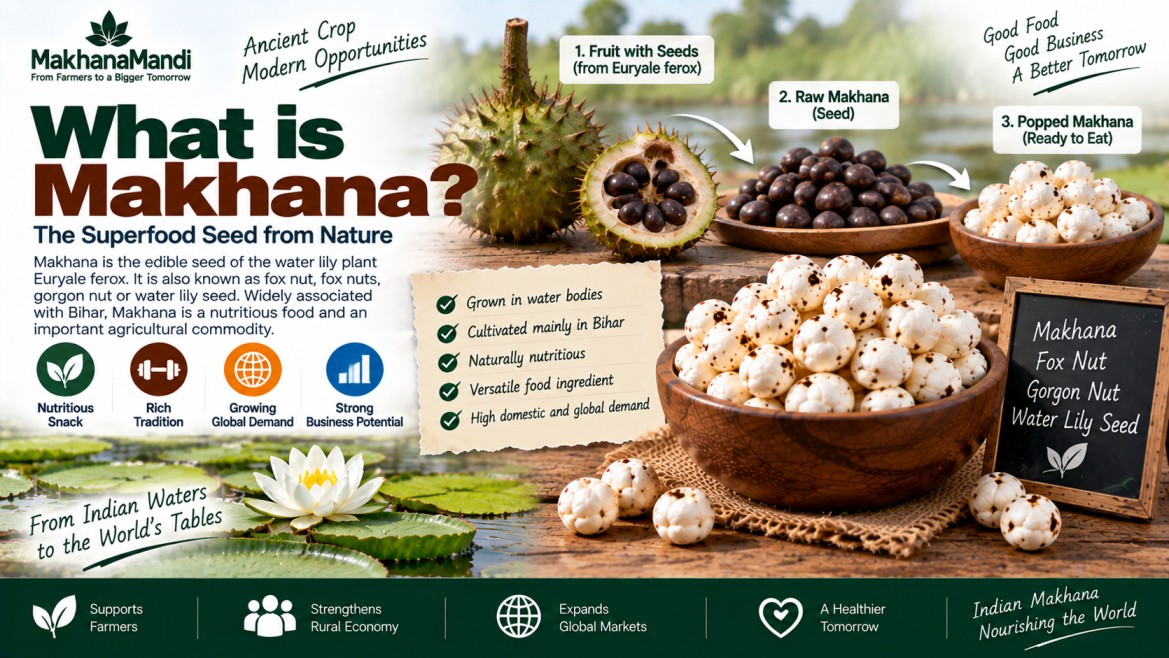
Makhana is the edible seed of the water lily plant Euryale ferox. It is also commonly known as fox nut, fox nuts, gorgon nut, or water lily seed. In India, Makhana is especially associated with Bihar, where it has a long history of cultivation, processing and trade.
Makhana is widely consumed as a roasted snack, but the raw seed also serves as a traded agricultural commodity and a raw material for processors, food manufacturers, private-label brands and other businesses. Understanding what Makhana is requires looking at the product from both food and commercial perspectives.
What is Makhana made from?
Makhana comes from the seeds of Euryale ferox, an aquatic plant that grows in ponds and other suitable water bodies. The plant produces spiky fruits containing seeds. These seeds undergo several stages of collection, drying, processing and popping before becoming the familiar white Makhana commonly sold as a food product.
The edible popped product is light, crisp and relatively neutral in flavour, which makes it suitable for roasting and seasoning. Depending on the processing method and intended market, Makhana may be sold as raw material, popped Makhana, roasted Makhana or a value-added packaged snack.
Why is Makhana also called fox nut?
The term “fox nut” is one of the common English names used for Makhana. “Fox nuts” is also widely used in international food and business searches. Other names, including gorgon nut and water lily seed, may appear in trade, scientific or regional contexts.
For businesses operating across markets, it is useful to recognize these different names because buyers and suppliers may use different terminology when describing essentially the same underlying product.
Where does Makhana come from?
Makhana is cultivated in several parts of Asia, and India is an important producer and processor. Within India, Bihar is particularly important to the Makhana value chain, with production, processing and trading activity spread across multiple districts.
Makhana from different producing regions can enter domestic and international supply chains through farmers, aggregators, traders, processors, manufacturers, exporters and distributors. This creates a supply chain extending from cultivation and harvesting through processing, grading, packaging and final sale.
How is Makhana produced?
Makhana production involves considerably more than simply harvesting a seed. The broad process includes cultivation, collection of seeds from water bodies, cleaning, drying, storage and traditional or mechanized processing.
One important stage is popping. Raw Makhana seeds are processed under controlled conditions to produce the familiar expanded white product. The quality of the final popped Makhana can depend on seed characteristics, processing skill, heat control, moisture management and sorting.
What are Makhana grades?
Makhana is commonly differentiated by size and quality. In Indian trade, size is often described using the term Suta. Grade specifications help buyers and sellers communicate the approximate size of the product being offered.
Commercial buyers should avoid relying only on informal descriptions such as “premium” or “large.” A useful specification should identify the applicable grade and, where necessary, include quality characteristics, uniformity, broken percentage and other agreed parameters.
For a transaction, the grade should be considered together with quantity, origin, quality, packaging and other commercial conditions. Two products with similar descriptions may not be equivalent if their underlying specifications differ.
What is the difference between raw Makhana and popped Makhana?
Raw Makhana refers to the seed before it has undergone the popping process that produces the familiar expanded food product. Raw material is relevant to processors and businesses involved in further processing.
Popped Makhana is the expanded edible product that consumers commonly recognize as Makhana. It can be sold plain, roasted, seasoned, flavoured or incorporated into other food products.
The commercial value and handling requirements of raw and popped Makhana are different, so buyers should always specify which form they require.
How is Makhana sold?
Makhana can be sold through several commercial formats depending on the buyer and intended use. Bulk agricultural and processed-product transactions may involve kilogram or larger-volume quantities, while consumer products may be sold in jars, pouches or other retail packaging.
Commercial listings may specify:
- Product form
- Grade or Suta
- Quantity
- Minimum order quantity
- Price and price unit
- Origin
- Packaging
- Processing method
- Produce year where relevant
- Delivery and payment terms
These details are important because a headline price without a product specification can be misleading when comparing offers.
Why is Makhana important as a business commodity?
Makhana sits at the intersection of agriculture, food processing, wholesale trade and consumer packaged foods. The value chain can involve farmers, producer organizations, local traders, processors, manufacturers, exporters, distributors, retailers and food brands.
Businesses may participate in different parts of this chain. A farmer may focus on cultivation and raw seed production, while a processor may specialize in popping, grading and packing. A food company may purchase processed Makhana for roasting, flavouring or private-label products.
This diversity means that “Makhana business” does not describe one single business model. Procurement requirements, margins, equipment, quality controls, packaging and customers can differ substantially across the value chain.
What affects the commercial price of Makhana?
Makhana prices are not determined by one universal rate. Commercial quotations can vary according to grade, quality, availability, origin, quantity, processing, packaging and market conditions.
For a meaningful comparison, buyers should examine equivalent specifications. A quotation for a particular Suta grade should not automatically be compared with a quotation for another grade. Similarly, a bulk raw-material quotation is not directly comparable with a branded retail-ready product.
Order size can also matter. Minimum order quantity, freight, payment terms and delivery location may affect the effective landed cost for a buyer.
How should businesses buy Makhana?
Businesses should begin by defining exactly what they need. A procurement specification can include the product form, grade, quality requirements, quantity, origin preference, packaging, delivery location and commercial terms.
For larger purchases, businesses should consider requesting representative samples and confirming agreed specifications before dispatch. Supplier verification and clear written commercial terms are also important for reducing misunderstandings.
A marketplace can help with price discovery by allowing buyers to compare multiple offers, but the final commercial decision should be based on verified product specifications and terms rather than price alone.
Makhana in the global market
Makhana is increasingly relevant beyond India's domestic snack market. International buyers may encounter the product under names such as fox nuts, foxnut, gorgon nut or water lily seed.
Export transactions can introduce additional considerations such as destination-country food regulations, packaging and labelling requirements, documentation, product specifications, logistics and importer requirements. These requirements should be checked for the specific destination rather than assumed to be identical across countries.
For international trade, clear product terminology is particularly useful. A supplier and buyer should establish exactly what product is being traded and which specifications apply before negotiating a shipment.
How MakhanaMandi fits into the Makhana ecosystem
MakhanaMandi is built around the broader Makhana business ecosystem, connecting information about Makhana with businesses, buyers, sellers and marketplace activity.
For someone entering the Makhana business, marketplace information can help answer practical questions such as what grades are being offered, what quantities are available, where products originate and which suppliers are active. Buyers can use such information as part of their procurement research while still verifying the final product and commercial terms directly.
Frequently asked questions
What is Makhana?
Makhana is the edible seed of the aquatic plant Euryale ferox. It is commonly known as fox nut or fox nuts and is widely consumed as a snack after processing and popping.
Is Makhana the same as fox nuts?
Yes. “Fox nuts” and “fox nut” are common English names used for Makhana. Other names such as gorgon nut and water lily seed may also be encountered.
Where is Makhana mainly produced in India?
Bihar is a major Makhana-producing region in India. The broader Indian Makhana value chain includes cultivation, processing, trading, manufacturing and distribution across multiple locations.
What is Suta in Makhana?
Suta is a commonly used Indian trade term for describing Makhana size grades. Buyers should confirm the exact grading specification when purchasing because grade is an important part of product comparison.
Is Makhana a raw material or a finished food?
It can be both, depending on the stage of the value chain. Raw Makhana seed is a processing input, while popped Makhana can be sold as a finished food product or used to make roasted, flavoured and other value-added products.
Is Makhana suitable for export?
Makhana is traded internationally, but export requirements depend on the product, destination and transaction. Exporters should verify the applicable food, labelling, documentation and destination-country requirements before shipping.
How should I compare Makhana suppliers?
Compare equivalent grade and quality specifications along with quantity, MOQ, origin, packaging, processing, price, freight, payment terms and delivery conditions. For significant purchases, sample evaluation and supplier verification can also be important.
Bottom line
Makhana is the edible seed of Euryale ferox, widely known as fox nut or fox nuts. It is both a traditional food and a commercial agricultural and processed-food commodity with a growing value chain.
Understanding Makhana starts with the product itself, but businesses also need to understand grading, processing, sourcing, quality, pricing and trade requirements. Whether you are a farmer, trader, processor, manufacturer, exporter or buyer, clear specifications and reliable market information are essential for making better Makhana business decisions.