
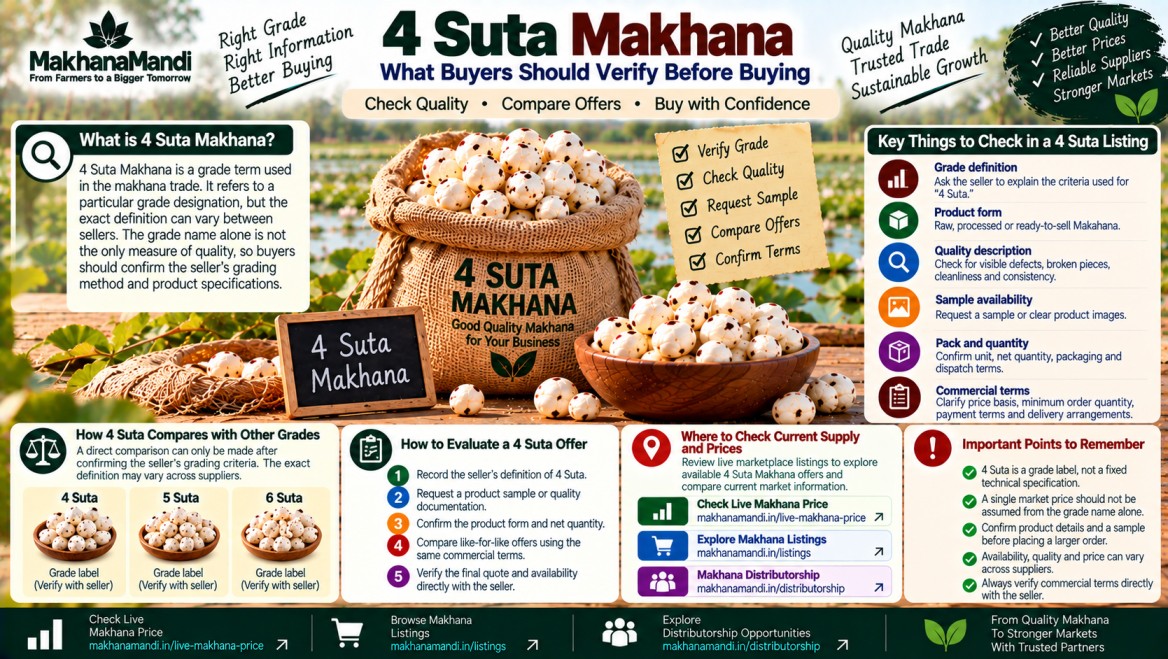
4 Suta Makhana is a Makhana grade term that buyers may encounter while comparing products, listings, or supplier offers. However, a grade name by itself does not provide enough information to judge a shipment. Buyers should confirm the seller's grading method, product specifications, sample quality, and commercial terms before making a purchase.
The available Makhana marketplace research identifies exact evidence for the term “4 Suta Makhana,” but it does not provide a verified technical specification that defines the term by size, count, weight, yield, or quality standard. For that reason, this page treats 4 Suta as a grade label requiring seller-side verification rather than assigning it an unsupported specification.
What does 4 Suta Makhana mean?
In the available research context, 4 Suta Makhana is classified as a Makhana grade. The context confirms that the term appears in marketplace evidence, but it does not establish a universal definition for the label. Different sellers may therefore need to explain how they apply the grade in their own product descriptions or trade documentation.
Before comparing two offers, ask whether both sellers use the same grading criteria. A shared label does not automatically mean that the products have identical appearance, size distribution, processing quality, moisture condition, breakage level, or pack composition.
In terms of size, 1 Suta = 3.17 mm under the grading convention used in this article. Accordingly, 4 Suta corresponds to 12.68 mm (3.17 × 4), with the next grade boundary at 5 Suta (15.85 mm). Buyers should confirm with the supplier whether this measurement refers to popped makhana and how the product is measured and sorted for grading, as grading practices may vary.
Comparing 4, 5 and 6 Suta Makhana Sizes
Using the grading convention that 1 Suta = 3.17 mm, the following table shows the calculated size range for each grade. The lower boundary is included, while the upper boundary is excluded.
| Grade | Minimum size (inclusive) | Upper boundary (exclusive) | Size range |
|---|---|---|---|
| 4 Suta | 4 × 3.17 = 12.68 mm | 5 × 3.17 = 15.85 mm | 12.68 mm to less than 15.85 mm |
| 5 Suta | 5 × 3.17 = 15.85 mm | 6 × 3.17 = 19.02 mm | 15.85 mm to less than 19.02 mm |
| 6 Suta | 6 × 3.17 = 19.02 mm | 7 × 3.17 = 22.19 mm | 19.02 mm to less than 22.19 mm |
Explore adjacent grades: compare 5 Suta Makhana and 6 Suta Makhana to understand how the size ranges differ. Confirm the actual grading specification with your supplier before purchasing.
These ranges are mathematical interpretations of the stated grading convention, not a guarantee of a universal industry standard. Actual grading practices may vary. Buyers should confirm with suppliers whether the measurement refers to popped makhana and how the product is measured and sorted before purchasing.
What should buyers check in a 4 Suta Makhana listing?
- Grade definition: Ask the seller to explain the criteria used for “4 Suta.”
- Product form: Confirm whether the offer is for raw, processed, or ready-to-sell Makhana.
- Quality description: Request information about visible defects, broken pieces, cleanliness, and consistency where relevant to the transaction.
- Sample availability: Ask whether a sample can be reviewed before confirming a larger order.
- Pack and quantity: Confirm the unit, net quantity, packaging, and dispatch terms.
- Commercial terms: Clarify the price basis, minimum order quantity, payment terms, and delivery arrangements directly with the seller.
These checks are especially important because the research record does not supply a standard technical table for 4 Suta Makhana. A buyer should rely on documented seller information and a product sample rather than assuming that the grade name has one fixed meaning across the market.
Is 4 Suta Makhana the same as other Suta grades?
No universal comparison can be made from the available evidence alone. The research also identifies marketplace opportunities for other Suta grade terms, including 5 Suta and 6 Suta, but it does not provide verified specifications that establish how those labels differ from 4 Suta.
When comparing grades, request the seller's own grade chart or specification sheet. Compare products using the same criteria and sample conditions instead of relying only on the number in the grade name.
How can buyers compare a 4 Suta offer with the market?
Start by separating grade information from price information. A current market quote may vary according to product condition, quantity, location, packaging, and transaction terms. The available research does not provide a verified price for 4 Suta Makhana, so buyers should not treat a general Makhana price as a confirmed 4 Suta rate.
For current market information, consult the live Makhana price page when relevant, then ask the seller whether the quoted amount applies to the same grade, product form, quantity, and delivery basis.
Where can buyers review available Makhana offers?
Buyers can review relevant Makhana marketplace listings and use the listing details to identify sellers, product descriptions, and available transaction information. Treat each listing as a starting point for due diligence: confirm the grade definition and other specifications directly before committing.
Businesses evaluating a longer-term Makhana opportunity can also review the Makhana distributorship information, provided that the model and commercial requirements match their needs.
Buyer checklist for 4 Suta Makhana
- Record the seller's definition of 4 Suta.
- Request a product sample or clear quality documentation.
- Confirm the product form and net quantity.
- Compare like-for-like offers using the same commercial terms.
- Verify the final quote and availability directly with the seller.
Conclusion
4 Suta Makhana should be approached as a grade label that requires clarification, not as a specification that can be assumed without evidence. The available marketplace research confirms interest and exact evidence for the term, but it does not establish a universal technical definition or current price. Buyers can make better decisions by requesting the seller's grading criteria, reviewing a sample, and comparing complete offers on a like-for-like basis.
