
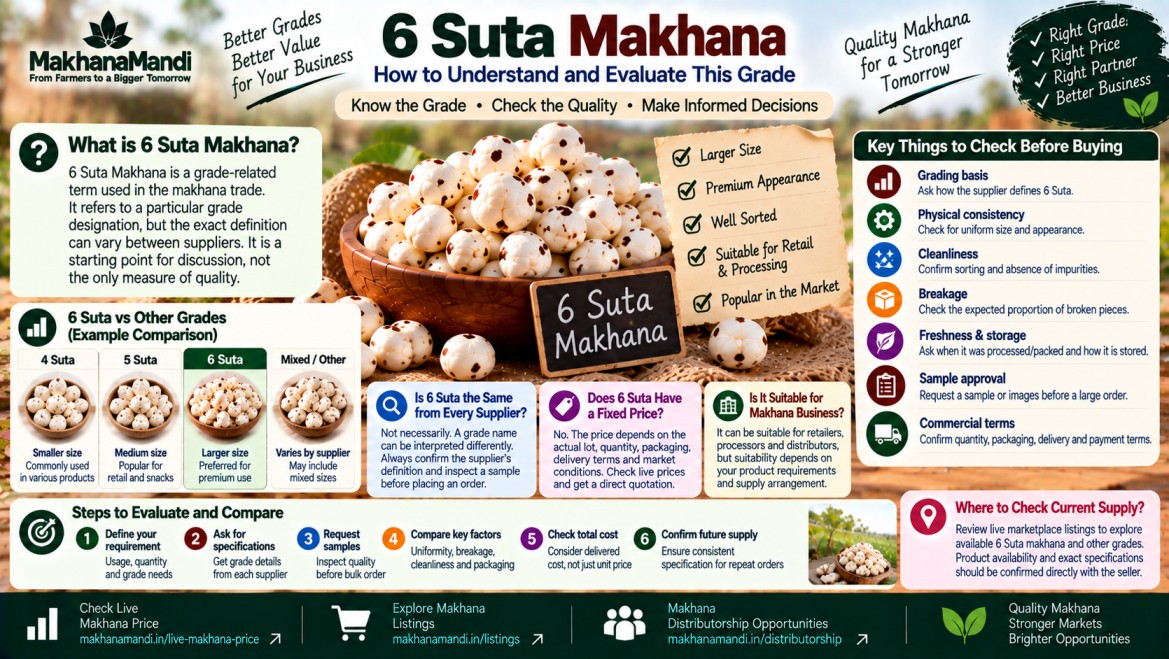
6 Suta Makhana is a grade-related term used in the makhana trade. Buyers researching this grade should treat the label as a starting point rather than the only measure of quality. The practical details—such as consistency, cleanliness, breakage, packaging, quantity, and final price—should be confirmed with the seller before placing an order.
What is 6 Suta Makhana?
6 Suta Makhana refers to a particular grade designation for makhana. The available research identifies it as part of the “Grades, Quality, and Variations” topic cluster, but it does not provide a universal technical specification for the label. That means buyers should avoid assuming that every supplier uses the term in exactly the same way.
When comparing offers, ask the supplier how they define 6 Suta for that lot and whether the grade is based on size, sorting, appearance, or another internal classification. A clear seller should be able to explain the grading basis and share relevant product details.
In terms of size, 1 Suta = 3.17 mm. Accordingly, 6 Suta Makhana measures approximately 19.02 mm (3.17 × 6) in size, up to but less than 7 Suta (22.19 mm), based on this grading convention. Buyers should confirm with the supplier whether the stated Suta measurement refers to the size of the popped makhana and how the product is measured and sorted for grading.
Comparing 4, 5 and 6 Suta Makhana Sizes
Using the grading convention that 1 Suta = 3.17 mm, the following table shows the calculated size range for each grade. The lower boundary is included, while the upper boundary is excluded.
| Grade | Minimum size (inclusive) | Upper boundary (exclusive) | Size range |
|---|---|---|---|
| 4 Suta | 4 × 3.17 = 12.68 mm | 5 × 3.17 = 15.85 mm | 12.68 mm to less than 15.85 mm |
| 5 Suta | 5 × 3.17 = 15.85 mm | 6 × 3.17 = 19.02 mm | 15.85 mm to less than 19.02 mm |
| 6 Suta | 6 × 3.17 = 19.02 mm | 7 × 3.17 = 22.19 mm | 19.02 mm to less than 22.19 mm |
Explore adjacent grades: compare 4 Suta Makhana and 5 Suta Makhana to understand how the size ranges differ. Confirm the actual grading specification with your supplier before purchasing.
These ranges are mathematical interpretations of the stated grading convention, not a guarantee of a universal industry standard. Actual grading practices may vary. Buyers should confirm with suppliers whether the measurement refers to popped makhana and how the product is measured and sorted before purchasing.
What should buyers check before purchasing?
- Grading basis: Ask what the seller means by “6 Suta” and whether the same standard applies throughout the lot.
- Physical consistency: Confirm whether the batch is uniform or contains mixed sizes and grades.
- Cleanliness: Ask about visible impurities, foreign material, and the sorting process.
- Breakage: Check the expected proportion of broken or damaged makhana.
- Freshness and storage: Confirm when the product was processed or packed and how it has been stored.
- Sample approval: For business purchases, request a sample or representative product images before confirming a larger order.
- Commercial terms: Confirm quantity, packaging, delivery terms, payment terms, and the final quoted price.
Is 6 Suta Makhana the same from every supplier?
Not necessarily. A grade name can be interpreted differently across suppliers unless the buyer and seller agree on the specification. This is why a purchase decision should compare the actual product and commercial terms, not just the grade name.
For a reliable comparison, record the supplier’s description, sample observations, pack size, quoted price, and delivery conditions. This creates a clearer basis for comparing two 6 Suta offers.
How to compare 6 Suta Makhana with other grades
Compare grades using the criteria that matter for your intended use. A household buyer may focus on appearance, cleanliness, taste after roasting, and pack size. A retailer, processor, or distributor may also need consistent sorting, repeat availability, packaging options, and dependable fulfilment.
- Define the intended use and required quantity.
- Ask each supplier for the grade description and product specifications.
- Request samples when the order is significant.
- Compare uniformity, breakage, cleanliness, and packaging.
- Check the complete delivered cost rather than comparing only a headline price.
- Confirm whether future lots will follow the same specification.
Where can buyers check current makhana supply?
Supply and seller availability can change, so buyers should review current marketplace listings rather than rely only on an older article or an informal quotation. The MMX makhana listings can help buyers explore available offers and identify sellers to contact. Product availability and the exact 6 Suta specification should still be confirmed directly with the listing party.
Does 6 Suta Makhana have a fixed price?
A single fixed price should not be assumed from the grade name alone. The final quote may depend on the actual lot, quantity, packaging, delivery terms, seller, and market conditions. The supplied research does not provide a verified current price specifically for 6 Suta Makhana.
For current market information, consult the live makhana price page where relevant, then request a direct quotation for the exact grade, quantity, and delivery destination.
Is this grade suitable for a makhana business?
It may be considered by retailers, processors, distributors, or other buyers, but suitability depends on the buyer’s product requirements and supply arrangement. Before committing, test the product, assess repeat availability, and confirm whether the supplier can maintain the agreed specification across future orders.
Businesses exploring a wider opportunity in the makhana trade can also review MMX distributorship information. That resource is separate from the technical evaluation of the 6 Suta grade, so commercial terms should be reviewed independently.
Key takeaway
6 Suta Makhana is a grade label, but the label alone is not a complete product specification. The safest approach is to ask the supplier to define the grade, inspect or sample the product, compare quality and commercial terms, and confirm the delivered order details in writing.
