
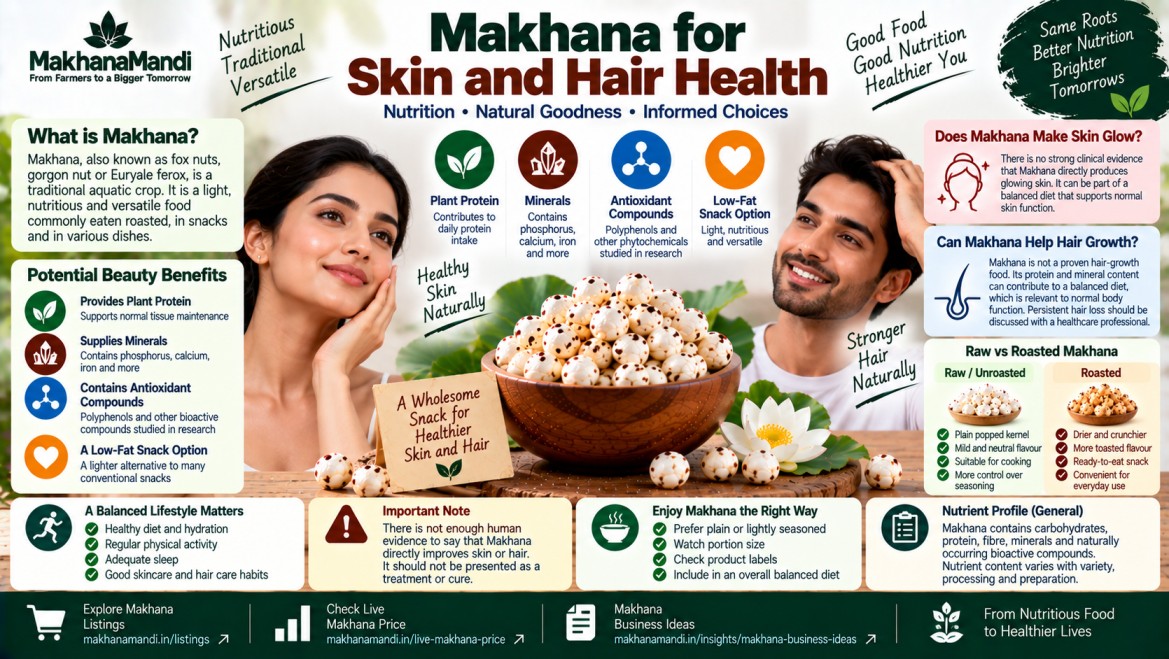
Short answer: Makhana (fox nuts, Euryale ferox) can be part of a balanced diet that supports overall nutrition, but there is not enough human clinical evidence to say that eating Makhana directly improves skin or hair. Its protein, minerals and naturally occurring bioactive compounds make it an interesting food from a nutrition perspective, while claims about glowing skin, hair growth or reversing hair loss should be treated cautiously.
Why Is Makhana Associated With Skin and Hair Health?
Skin and hair depend on adequate nutrition. Protein, minerals, vitamins and other nutrients contribute to normal tissue maintenance and growth. Makhana is a relatively low-fat seed food that provides carbohydrates, protein and minerals, and research on Euryale ferox has also identified various bioactive compounds, including polyphenols and other phytochemicals.
That nutritional profile provides a reasonable basis for including Makhana in a varied diet. However, it is important to distinguish between supporting normal nutrition and claiming a specific cosmetic or medical effect.
Potential Beauty Benefits of Makhana
1. Provides Plant Protein
Protein is an important structural component of the body and is particularly relevant to tissues such as skin and hair. Makhana contains protein, although the amount consumed in a normal snack portion is only one part of the overall diet.
Eating Makhana therefore can contribute to daily protein intake, especially when combined with other protein-rich foods. It should not, however, be presented as a treatment for hair thinning or hair loss.
2. Supplies Minerals
Published nutritional research reports minerals such as phosphorus, calcium and iron in Makhana. Minerals have many physiological roles, and adequate dietary intake is important for normal body function.
The practical point is simple: Makhana can contribute to dietary mineral intake, but the actual contribution depends on the serving size, processing method and the rest of the diet.
3. Contains Antioxidant-Related Compounds
Research on Euryale ferox has reported antioxidant activity and identified several phytochemicals, including polyphenols. Laboratory research has found antioxidant activity in Makhana extracts, while later reviews have summarized a broader range of bioactive compounds.
These findings are scientifically interesting, but antioxidant activity measured in extracts or laboratory models does not automatically demonstrate that eating Makhana will reduce wrinkles, pigmentation, acne or other skin conditions in humans.
4. A Low-Fat Snack Option
Makhana is naturally low in fat compared with many conventional snack foods. Plain roasted Makhana can therefore be useful as part of a balanced snack pattern, particularly when it is prepared without excessive oil, sugar or salt.
For beauty and general wellness, the overall eating pattern matters much more than any single food.
Does Makhana Make Skin Glow?
There is no strong clinical evidence establishing Makhana as a food that directly produces brighter or glowing skin.
A nutritious diet can support normal skin function, and Makhana can contribute some protein and minerals to that diet. But visible skin appearance is influenced by many factors, including genetics, age, sun exposure, sleep, hydration, overall diet and skincare habits.
Therefore, it is more accurate to describe Makhana as a nutritious snack that can fit into a skin-supportive diet rather than as a natural skin-brightening treatment.
Can Makhana Help Hair Growth?
Makhana should not be marketed as a proven hair-growth food. Hair growth and hair loss involve multiple biological and nutritional factors, and there is no established clinical evidence showing that eating Makhana alone stimulates hair growth.
Its protein and mineral content can contribute to an adequate diet, which is relevant to normal body function. However, persistent hair loss can have many causes and should not automatically be attributed to a lack of Makhana or another single food.
Makhana Nutrients Relevant to Skin and Hair
Nutritional aspect Why it matters What Makhana can contribute
Protein | Supports normal tissue maintenance | Provides plant protein as part of the overall diet
Minerals | Support numerous physiological processes | Contains minerals including phosphorus and calcium
Bioactive compounds | Studied for antioxidant-related activity | Research has identified polyphenols and other compounds
Low fat | Can help make a snack less fat-dense than some alternatives | Plain Makhana is naturally low in fat
Important: Nutritional composition varies with raw material, processing and measurement method. A food's nutrient content should not be interpreted as proof of a specific cosmetic or medical benefit.
Raw Makhana vs Roasted Makhana for Beauty Nutrition
For everyday eating, roasted Makhana is generally the more convenient form because it is ready to eat and has a crisp texture. Raw Makhana is an ingredient that requires further processing before it is normally consumed as a snack.
If the goal is a simple nutritious snack, plain or lightly seasoned roasted Makhana can be a practical choice. Excessive oil, sugar or salt can change the nutritional profile of a prepared Makhana product.
See our detailed comparison: Roasted Makhana vs Raw Makhana: Which Is Better?
How to Include Makhana in a Balanced Diet
- Choose plain or lightly roasted Makhana for regular snacking.
- Combine it with other nutritious foods rather than relying on it as a single source of nutrition.
- Use reasonable portions according to your overall calorie and dietary needs.
- Check the ingredient and nutrition information on flavoured or packaged products.
- Maintain variety by including fruits, vegetables, pulses, nuts, seeds and other protein sources.
You can also explore Makhana products and suppliers on MakhanaMandi when comparing available products.
What About Makhana Face Packs or DIY Hair Treatments?
Food-based beauty remedies often circulate online, including suggestions to make face packs or hair treatments from Makhana powder. Such uses should not be confused with established dermatological treatments.
There is insufficient clinical evidence to recommend Makhana powder as a treatment for acne, pigmentation, wrinkles, dandruff, hair loss or other skin and scalp conditions. Applying a food ingredient directly to the skin can also cause irritation or allergic reactions in some people.
For persistent skin or scalp problems, evidence-based skincare and professional medical advice are more appropriate than relying on a DIY Makhana remedy.
What Does Scientific Research Actually Say?
Research on Euryale ferox has documented its nutritional composition and investigated its phytochemicals and antioxidant properties. A review published in Molecules describes compounds such as polyphenols and other bioactive constituents in Makhana and summarizes experimental pharmacological findings.
Another review describes Makhana as a food crop containing carbohydrate, protein and minerals. Laboratory studies have also reported antioxidant activity in extracts of Euryale ferox.
These findings support continued nutritional and biochemical research, but they do not establish that eating Makhana produces a specific beauty outcome in humans. More human research would be required before making such claims.
Frequently Asked Questions
Is Makhana good for skin?
Makhana can be part of a balanced diet that provides protein and minerals, but there is not enough clinical evidence to claim that it directly improves skin appearance.
Does Makhana make skin glow?
There is no strong human clinical evidence showing that Makhana directly causes glowing skin. Its nutritional value can contribute to an overall healthy diet.
Does Makhana help hair growth?
Makhana provides protein and minerals, but there is no established evidence that eating Makhana alone stimulates hair growth or treats hair loss.
Can Makhana reduce wrinkles?
No reliable clinical evidence currently establishes Makhana as an anti-wrinkle food or treatment.
Can I use Makhana powder on my face?
There is insufficient clinical evidence to recommend Makhana powder as a skincare treatment. A food ingredient can also irritate sensitive skin, so established skincare products are generally more appropriate.
Is roasted Makhana suitable as a daily snack?
Plain or lightly seasoned roasted Makhana can fit into a balanced diet. Portion size and the ingredients added during roasting are important considerations.
Bottom Line
Makhana has a useful nutritional profile and contains protein, minerals and bioactive compounds that have been investigated in scientific research. These characteristics make it a reasonable food to include in a varied diet.
However, the evidence does not justify presenting Makhana as a proven beauty treatment. Claims that it guarantees glowing skin, stops hair fall, grows hair faster or removes wrinkles go beyond what current evidence establishes. For skin and hair health, think of Makhana as one nutritious food within a broader healthy lifestyle, not as a standalone cosmetic remedy.
Further Reading and References
- The Ethnopharmacological, Phytochemical, and Pharmacological Review of Euryale ferox Salisb. – PubMed
- Euryale ferox, a prominent superfood: Nutritional, pharmaceutical, and its economical importance – PubMed
- Antioxidant activity of extracts from Euryale ferox seed – PubMed
- Makhana (Euryale ferox Salisb.): A high-valued aquatic food crop – ScienceDirect
Evidence note: This article distinguishes nutritional composition and laboratory research from demonstrated human clinical benefits. It does not claim that Makhana treats skin, scalp or hair disorders.
