
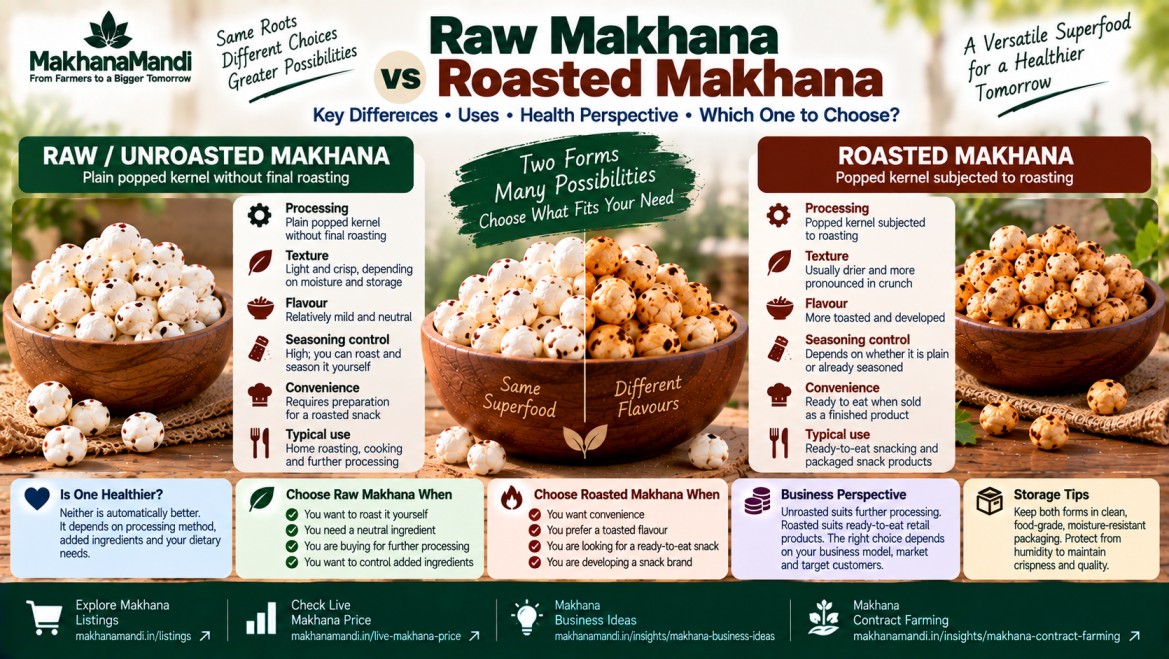
Short answer: neither roasted Makhana nor raw Makhana is automatically better in every situation. The better choice depends on how you plan to use it. Plain roasted Makhana is convenient for ready-to-eat snacking, while raw or unroasted popped Makhana gives you more control over roasting, seasoning and cooking.
Makhana, also known as fox nuts, gorgon nut or Euryale ferox, is commonly traded and consumed as an expanded or popped kernel. In everyday conversation, the term "raw Makhana" often means plain, unroasted popped Makhana rather than the original unprocessed seed. That distinction is important when comparing the two forms.
What is the difference between raw and roasted Makhana?
The main difference is processing after the Makhana kernel has been obtained. Raw or unroasted popped Makhana has not undergone the final roasting step. Roasted Makhana has been heated to develop a drier texture and a characteristic roasted flavour.
| Factor | Raw / Unroasted Makhana | Roasted Makhana |
|---|---|---|
| Processing | Plain popped kernel without final roasting | Popped kernel subjected to roasting |
| Texture | Light and crisp, depending on moisture and storage | Usually drier and more pronounced in crunch |
| Flavour | Relatively mild and neutral | More toasted and developed |
| Seasoning control | High; you can roast and season it yourself | Depends on whether it is plain or already seasoned |
| Convenience | Requires preparation for a roasted snack | Ready to eat when sold as a finished roasted product |
| Typical use | Home roasting, cooking and further processing | Ready-to-eat snacking and packaged snack products |
Is roasted Makhana healthier than raw Makhana?
It is better not to make a blanket health claim that one form is always healthier. Roasting changes the physical properties of the kernel, especially moisture and texture, while the final nutritional profile also depends on the roasting method and whether ingredients such as oil, salt, sugar or flavouring are added.
Plain roasted Makhana can therefore be a convenient snack, but a seasoned product should be assessed based on its complete ingredient list rather than the word "Makhana" alone. If you are comparing two packaged products, check the nutrition information and added ingredients on their labels.
Research on Euryale ferox and its processing has examined drying, roasting, popping and related changes in the product. Processing conditions matter, so exact changes should not be generalized across every Makhana product.
When should you choose raw Makhana?
- You want to roast it yourself: You can control roasting time, temperature and seasoning.
- You want a neutral ingredient: Unroasted Makhana can be incorporated into recipes without a strong roasted flavour.
- You are buying for further processing: Raw or unroasted popped kernels can be suitable for businesses that perform their own roasting and flavouring.
- You want to control added ingredients: Home preparation lets you decide whether to use oil, salt or other seasonings.
When should you choose roasted Makhana?
- You want convenience: Plain roasted Makhana can be consumed directly from the pack.
- You prefer a toasted flavour: Roasting produces a more developed aroma and taste.
- You are looking for a ready-to-eat snack: Packaged roasted Makhana is designed for immediate consumption.
- You are developing a snack brand: Roasted Makhana can be sold as a plain or flavoured finished product.
Does roasting change the moisture of Makhana?
Yes. Heating generally reduces moisture, although the actual result depends on the starting moisture, roasting conditions, equipment and duration. Moisture is important for crispness and storage stability, which is why commercial Makhana processing needs consistent handling and packaging.
For buyers and sellers, this is one reason product specifications should not be judged only by appearance. Grade, size, moisture, processing method, packaging and storage conditions can all influence the finished product.
Raw Makhana vs roasted Makhana for business
For the Makhana trade, the choice depends on the position of the buyer in the value chain. A wholesaler or processor may prefer unroasted material for further processing, while a retailer or consumer may prefer a finished roasted product.
MakhanaMandi provides a marketplace where buyers and sellers can explore available Makhana products and trading opportunities. You can browse current Makhana listings or check the live Makhana price page for market information.
For businesses exploring value addition, our resources on Makhana business ideas and Makhana contract farming provide additional context.
How to store roasted and raw Makhana
Makhana should be protected from moisture and excessive humidity because moisture can reduce its characteristic crispness. Use clean, food-grade, moisture-resistant packaging and keep the product in suitable storage conditions.
For roasted Makhana, packaging becomes particularly important because consumers expect the product to remain crisp after roasting. For unroasted Makhana intended for further processing, storage conditions are equally important because the raw material may later undergo roasting or other processing.
Which one should you buy?
If your priority is convenience and ready-to-eat snacking, plain roasted Makhana is the practical choice. If your priority is processing flexibility and control, raw or unroasted popped Makhana may be more suitable.
The most useful comparison is therefore not simply "roasted versus raw". Check the Makhana grade, size, moisture, processing method, ingredients, packaging and intended use before making a purchase.
Frequently Asked Questions
Is raw Makhana actually raw?
Not necessarily. In commercial usage, "raw Makhana" commonly refers to plain or unroasted popped Makhana. It should not automatically be interpreted as the original unprocessed seed.
Can raw Makhana be roasted at home?
Yes. Plain unroasted popped Makhana can be roasted at home, allowing the user to control the roasting process and seasoning.
Is roasted Makhana more crunchy?
Roasting normally produces a drier and more pronounced crunch, although the final texture also depends on moisture, roasting conditions, cooling and packaging.
Does roasting add calories?
Roasting itself does not necessarily mean that a large amount of additional energy is added. However, oil, sugar, flavour coatings and other ingredients used during preparation can change the nutritional value of the finished product.
Which Makhana is better for business?
That depends on the business model. Unroasted popped Makhana can suit further processing, while roasted Makhana can suit ready-to-eat retail products. Buyers should compare specifications, costs, packaging requirements and intended market.
References
- ScienceDirect — Research and review literature on Makhana / Euryale ferox
- ScienceDirect — Research concerning processing, drying, roasting and popping of Makhana
Note: This article is intended for general product and food information. Processing methods and nutritional outcomes can vary between products, so product-specific claims should be checked against the manufacturer or seller information.
