
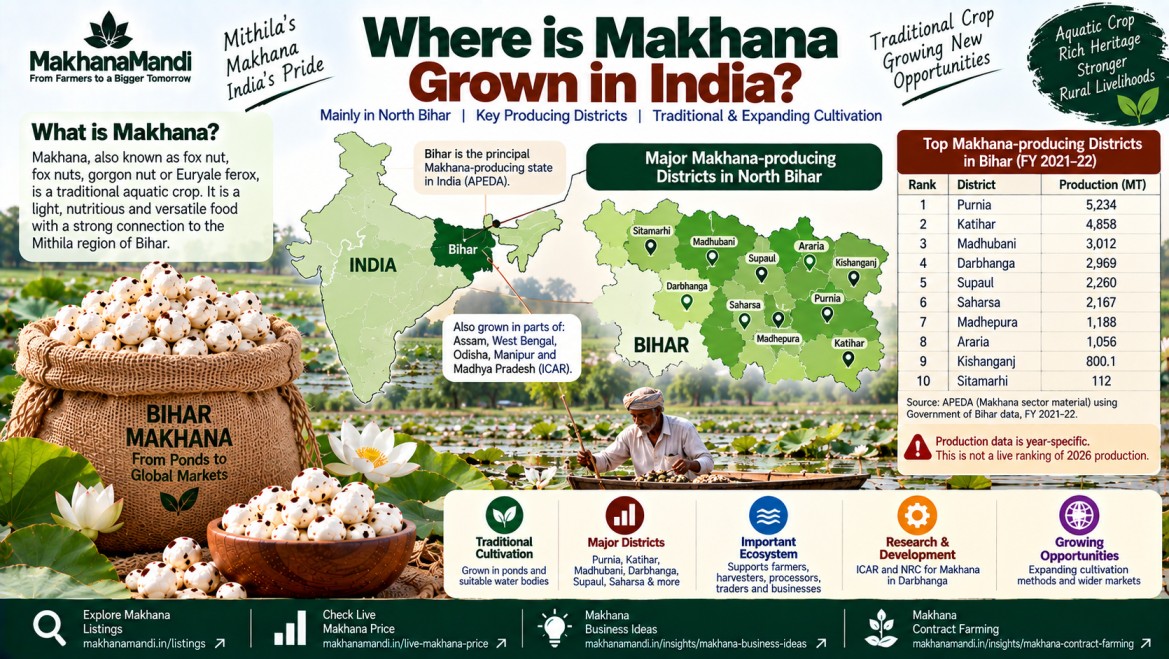
Short answer: Makhana is grown mainly in northern Bihar, particularly across the Mithila and surrounding regions. Purnia, Katihar, Madhubani, Darbhanga, Supaul and Saharsa are among the major producing districts. Makhana is an aquatic crop traditionally grown in ponds and other suitable water bodies, although improved cultivation systems have expanded the ways it can be produced.
Makhana, also known as fox nut, fox nuts, gorgon nut or Euryale ferox, has a particularly strong connection with Bihar. The crop is closely associated with the Mithila region and has developed into an important agricultural and commercial value chain involving farmers, harvesters, processors, traders and food businesses.
Where is Makhana mainly grown in India?
Bihar is the principal Makhana-producing state in India. APEDA reports that northern Bihar is particularly suitable for Makhana cultivation, with major production concentrated in districts including Madhubani, Darbhanga, Sitamarhi, Saharsa, Katihar, Purnia, Supaul, Kishanganj and Araria.
ICAR also describes commercial Makhana cultivation as being concentrated in North Bihar, while noting that the crop is also grown in other parts of India, including areas of Assam, West Bengal, Odisha, Manipur and Madhya Pradesh.
The exact geography changes over time as cultivation methods improve and farmers adopt new production systems. Therefore, a district identified as a traditional Makhana-growing area should not automatically be interpreted as having the same production volume every year.
Top Makhana-producing districts in Bihar
The following figures are based on district-wise Makhana production data for FY 2021–22 reported in APEDA's Makhana sector material using Government of Bihar data. They are presented as a dated production reference, not as current 2026 production estimates.
| Rank | District | Production (MT) |
|---|---|---|
| 1 | Purnia | 5,234 |
| 2 | Katihar | 4,858 |
| 3 | Madhubani | 3,012 |
| 4 | Darbhanga | 2,969 |
| 5 | Supaul | 2,260 |
| 6 | Saharsa | 2,167 |
| 7 | Madhepura | 1,188 |
| 8 | Araria | 1,056 |
| 9 | Kishanganj | 800.1 |
| 10 | Sitamarhi | 112 |
Important: production data is year-specific. The table above should not be presented as a live ranking of 2026 production without a newer official district-level dataset.
1. Purnia: one of Bihar's major Makhana regions
Purnia is an important centre in Bihar's Makhana ecosystem. APEDA's FY 2021–22 district data records approximately 5,234 tonnes of Makhana production, the highest figure among the districts shown in that dataset.
The district is also important for the wider commercial ecosystem around Makhana cultivation, processing and marketing. Purnia's role extends beyond farming because production regions need supporting activities such as aggregation, processing, grading, storage and trade.
2. Katihar: another major production centre
Katihar is another major Makhana-producing district in northeastern Bihar. APEDA's FY 2021–22 data records approximately 4,858 tonnes of production.
Its location within the broader Makhana-growing belt makes Katihar relevant to buyers and traders looking to understand where agricultural supply originates before it moves through processing and distribution channels.
3. Madhubani: a major Mithila Makhana district
Madhubani is one of the best-known Makhana-growing districts of the Mithila region. The APEDA dataset records approximately 3,012 tonnes in FY 2021–22.
Madhubani is also closely associated with the cultural and agricultural identity of Mithila Makhana. The district's importance illustrates why Makhana is not simply a commodity for Bihar but also part of the region's agricultural heritage.
4. Darbhanga: Makhana research and production centre
Darbhanga is another major Makhana district, with approximately 2,969 tonnes recorded in the FY 2021–22 APEDA dataset.
Darbhanga is particularly important because it combines production with research and technology development. ICAR has maintained Makhana research activities in Darbhanga, and the National Research Centre for Makhana has become an important institutional reference point for the crop.
This combination of farming, research, processing and trade makes Darbhanga significant throughout the Makhana value chain.
5. Supaul and Saharsa
Supaul and Saharsa are also important parts of the North Bihar Makhana belt. The FY 2021–22 figures reported by APEDA show approximately 2,260 tonnes from Supaul and 2,167 tonnes from Saharsa.
These districts demonstrate that Makhana production is distributed across a wider regional cluster rather than being concentrated in a single district.
Other Makhana-growing districts
Madhepura, Araria, Kishanganj and Sitamarhi are also included among the major Makhana-producing districts in the APEDA district dataset. Their reported FY 2021–22 production was approximately 1,188 tonnes, 1,056 tonnes, 800.1 tonnes and 112 tonnes respectively.
Other parts of Bihar may also have suitable conditions or developing cultivation activity. Production levels can change as farmers adopt improved varieties, field-based cultivation systems, better water management and mechanisation.
Why does Makhana grow well in North Bihar?
Makhana is an aquatic crop adapted to water-rich environments. Traditional cultivation has been associated with ponds, stagnant perennial water bodies, land depressions, oxbow lakes, swamps and similar environments.
ICAR has also developed cultivation technology that allows Makhana to be grown in shallow water under a field-based cropping system. This can provide farmers with alternatives to relying exclusively on traditional ponds and can support integration with subsequent crops.
The suitability of a location depends on more than simply having water. Water conditions, temperature, soil characteristics, labour availability, cultivation practices and access to processing and markets all influence the commercial viability of Makhana production.
Is Makhana grown only in Bihar?
No. Bihar is the dominant production region in India, but Makhana is not exclusive to Bihar.
ICAR identifies cultivation or commercial interest in states and regions including Assam, West Bengal, Odisha, Manipur and Madhya Pradesh. As cultivation technology develops, interest in Makhana production has also expanded into other areas.
However, Bihar remains especially important because of the scale of its production, the concentration of growers and processors, the established trading network and the historical connection of Makhana with Mithila.
Where does Mithila Makhana come from?
Mithila Makhana refers to Makhana associated with the geographically defined Mithila region and protected under India's Geographical Indications framework. The term is therefore more specific than simply saying "Makhana from India".
The Makhana-growing districts of North Bihar form an important part of this regional identity. Farmers produce the crop, while processors, traders and food businesses transform and distribute it through domestic and international markets.
From Makhana farm to market
Makhana production is only the beginning of the value chain. After cultivation and harvesting, seeds undergo drying, roasting, tempering and popping before the familiar white Makhana kernel is obtained. Further processing can include grading, roasting, flavouring, packaging and value addition.
ICAR has documented efforts to mechanise Makhana popping because traditional popping is labour-intensive. Mechanisation and improved processing can influence productivity, product quality and the economics of the value chain.
This is why the location of production matters to traders and buyers. A Makhana-producing district can also become a centre for aggregation, processing, storage and commercial activity.
What should buyers look for when sourcing Makhana?
- Production location: Understand where the Makhana was cultivated or where the seller operates.
- Grade and size: Compare the Makhana grade and Suta classification where applicable.
- Product form: Raw, roasted, flavoured and other processed forms have different specifications.
- Quality: Consider cleanliness, colour, moisture, breakage and other agreed quality parameters.
- Quantity: Confirm available stock and the seller's ability to supply consistently.
- Commercial terms: Compare price, freight, payment terms, dispatch time and packaging.
For current market information, buyers can check MakhanaMandi's live Makhana price page and explore available Makhana listings.
Frequently Asked Questions
Which state produces the most Makhana in India?
Bihar is the principal Makhana-producing state in India. The strongest production concentration is in North Bihar.
Which district produces the most Makhana?
In the APEDA district-wise dataset for FY 2021–22, Purnia recorded approximately 5,234 tonnes, followed by Katihar at approximately 4,858 tonnes.
Is Darbhanga a major Makhana-producing district?
Yes. Darbhanga is an important Makhana production and research centre. The FY 2021–22 APEDA dataset records approximately 2,969 tonnes of production in the district.
Is Makhana grown in Madhubani?
Yes. Madhubani is one of the important Makhana-growing districts of North Bihar and recorded approximately 3,012 tonnes in the FY 2021–22 APEDA dataset.
Can Makhana be grown outside Bihar?
Yes. Makhana is also grown or cultivated commercially in other parts of India, including areas of Assam, West Bengal, Odisha, Manipur and Madhya Pradesh. Bihar remains the country's principal production region.
Does Makhana grow only in ponds?
No. Traditional cultivation is strongly associated with ponds and other water bodies, but ICAR has developed field-based cultivation systems that allow Makhana to be grown in shallow water under suitable conditions.
Explore the Makhana market
Makhana production regions are connected to a much larger ecosystem of farmers, FPOs, processors, wholesalers, retailers and exporters.
Businesses can explore Makhana listings on MakhanaMandi, review live market prices, and learn more through our resources on Makhana business opportunities.
References
- APEDA — Market Intelligence Report: Makhana
- APEDA AgriExchange — Makhana Sector Report
- ICAR — Swarna Vaidehi: First Ever Variety of Makhana Released in India
- ICAR — Mechanizing Makhana Popping
Data note: District production figures in this article refer to FY 2021–22 data reported in APEDA material using Government of Bihar data. They should not be interpreted as current-year production estimates unless a newer official district-level dataset is available.
