
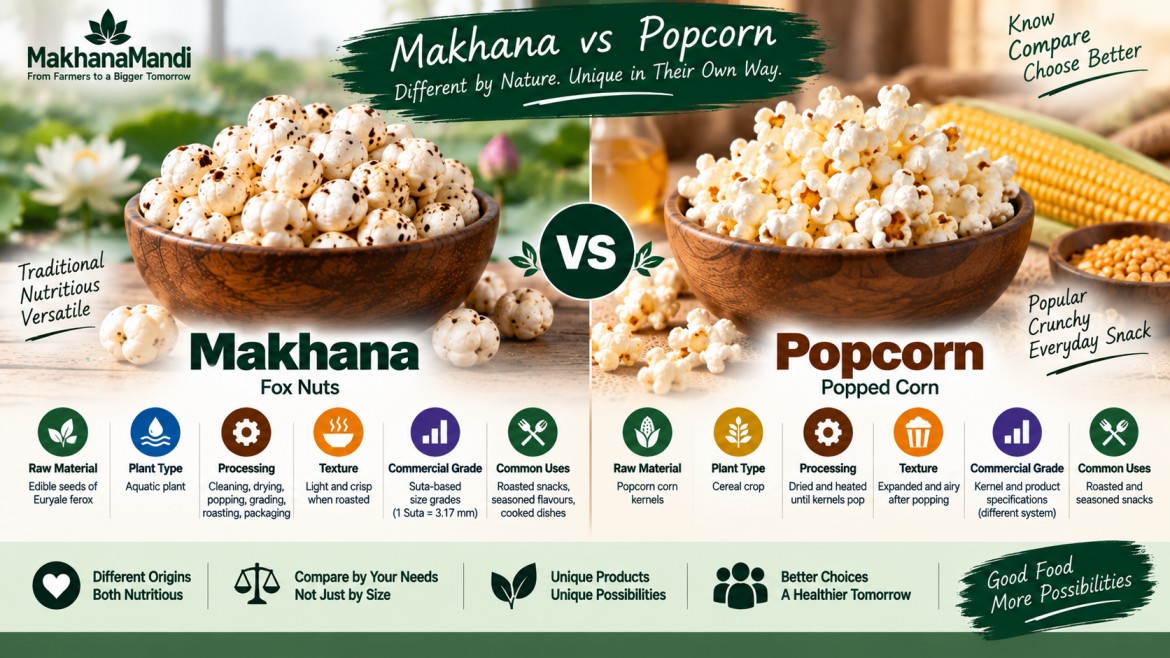
The difference between Makhana and popcorn is easiest to understand by looking at what each product is, how it is produced, how it is prepared and what characteristics matter to consumers and businesses. Makhana and popcorn can both be roasted and seasoned, but they are different products with different raw materials and processing characteristics.
The right comparison depends on the question being asked. Nutrition, texture, preparation, ingredients, commercial sourcing and intended use can all lead to different conclusions.
What are Makhana and popcorn?
Makhana is commonly used to refer to the edible seeds of the Euryale ferox plant, also known as fox nuts in many markets. The product can be processed, graded, roasted and prepared in different ways.
Popcorn is a type of corn whose kernels can expand and pop when heated under suitable conditions. It is commonly prepared as a snack and can be seasoned or combined with other ingredients.
Although both can become light, crunchy snacks after heating, their agricultural origin and processing are different.
Key difference between Makhana and popcorn
| Characteristic | Makhana | Popcorn |
|---|---|---|
| Raw material | Edible seeds of Euryale ferox | Popcorn corn kernels |
| Plant type | Aquatic plant | Cereal crop |
| Processing | Can involve drying, processing, popping, grading, roasting and packing | Typically involves drying and heating kernels until they pop |
| Typical texture | Light and crisp when suitably processed and roasted | Expanded and airy after popping |
| Commercial grading | Size and other product characteristics can be commercially specified | Kernel and finished-product characteristics can be specified differently |
| Preparation | Can be roasted, seasoned or incorporated into cooked dishes | Commonly popped and seasoned |
How are Makhana and popcorn processed?
Makhana processing
Makhana processing can involve several stages depending on the product and facility. These may include receiving raw material, cleaning, moisture management, processing or popping, cooling, grading, sorting, quality inspection and packaging.
For commercial operations, process control is important because product characteristics can vary with raw material, equipment and operating conditions.
See the MMX guide to Makhana processing plant for a broader explanation of commercial processing.
Popcorn processing
Popcorn is produced from kernels with characteristics that allow them to pop when heated. The kernel is heated until pressure develops and the structure expands into the familiar popped form.
The processing pathway is therefore fundamentally different from the processing chain used for Makhana.
Makhana versus popcorn: texture and eating experience
Both products can be crisp and light, but their textures are not identical. Roasted Makhana can have a light crunch and can be seasoned in many ways. Popcorn becomes expanded and airy after popping and has a characteristic irregular shape.
Preparation also affects the final experience. Oil, ghee, salt, spices, sugar or other ingredients can significantly change the taste and texture of either snack.
Nutrition comparison
Nutrition should be compared using a consistent serving size and reliable product-specific nutrition information. The nutritional profile of plain Makhana is not identical to that of popcorn, and preparation can change the final nutritional values substantially.
For example, adding oil, butter, sugar, cheese or other ingredients can materially change calories and macronutrient content. A fair comparison should therefore specify whether the products are plain, roasted, salted or prepared with additional ingredients.
For a detailed discussion of Makhana nutrition, see the MMX guide to Makhana nutrition facts.
Can Makhana be used like popcorn?
Makhana can be prepared as a roasted snack and seasoned in ways that are similar in spirit to seasoned popcorn. However, it does not become popcorn, because the two products come from different raw materials and have different structures.
Makhana can also be used beyond snack preparation. Roasted Makhana may be incorporated into cooked dishes, including curry-based preparations.
Makhana versus popcorn for recipes
Snack preparation
Both can be roasted or seasoned for snack use. Makhana can work well with savoury spice combinations, while popcorn is commonly associated with salted, buttered, caramel or other flavoured preparations.
Cooked dishes
Makhana can be used as an ingredient in cooked dishes where it absorbs flavours and changes texture during cooking. For example, it can be added to a curry.
Popcorn is generally used differently and is not normally treated as a substitute for Makhana in a gravy-based dish.
Makhana grade and popcorn kernel characteristics
Commercial Makhana can be described using size-related grades. Under the MakhanaMandi grading standard, 1 Suta = 3.17 mm. Whole-number grades represent diameter thresholds, while half grades represent intermediate size bands.
Popcorn is not graded using the Makhana Suta system. Its commercial characteristics are described using the conventions relevant to popcorn and corn products.
This is an important distinction for buyers: a Makhana grade should not be directly equated with a popcorn kernel classification.
Quality considerations
Quality should be assessed according to the product rather than simply asking which one is “better.” For Makhana, buyers may consider cleanliness, appearance, grade, consistency, processing condition, moisture-related condition and packaging.
For popcorn, relevant considerations can include kernel quality, popping performance, cleanliness, moisture condition and the characteristics required for the intended application.
In either case, product quality and product size are not necessarily the same thing.
Which is better: Makhana or popcorn?
There is no universal answer. The better option depends on the intended use, taste preference, preparation method, nutrition requirements and commercial considerations.
Someone looking for a particular texture or snack experience may prefer one product, while a food business may choose based on ingredient specifications, cost, supply consistency or product positioning.
The comparison should therefore be based on the actual characteristics relevant to the decision.
Commercial sourcing considerations
For businesses, the comparison is broader than consumer taste. Buyers may need to evaluate availability, grade, quantity, packaging, supplier capability, quality consistency and commercial terms.
Makhana buyers can compare actual marketplace listings and product specifications on MakhanaMandi rather than relying on a generic assumption about the entire category.
Similarly, a business sourcing popcorn should evaluate popcorn-specific specifications and supplier terms.
Common mistakes when comparing Makhana and popcorn
- Assuming that similar snack texture means the products are interchangeable.
- Comparing nutrition without using the same serving basis.
- Ignoring added oil, butter, sugar or seasoning.
- Comparing Makhana Suta grades with popcorn classifications.
- Judging quality only by size.
- Assuming one product is universally better for every use.
Frequently asked questions
What is the main difference between Makhana and popcorn?
Makhana and popcorn come from different plants and have different processing methods. Makhana comes from the edible seeds of Euryale ferox, while popcorn is produced from specific corn kernels that expand when heated.
Is Makhana healthier than popcorn?
Neither should be declared universally healthier without specifying the products and preparation methods being compared. Nutrition depends on serving size and ingredients added during preparation.
Can Makhana replace popcorn?
Makhana can serve as an alternative roasted snack for some consumers, but it is not the same product and does not have the same texture or preparation characteristics as popcorn.
Can Makhana be roasted like popcorn?
Makhana can be roasted and seasoned as a snack, but its processing and physical characteristics differ from popcorn. It should therefore be roasted using a method appropriate for Makhana rather than treating it as a corn kernel.
Does Makhana have grades like popcorn?
Makhana can be commercially classified by size using Suta-based grades. Under the MakhanaMandi standard, 1 Suta equals 3.17 mm. Popcorn uses different product and industry classifications.
Can Makhana be used in curry?
Yes. Makhana can be incorporated into cooked dishes such as curry, where it can absorb flavours and develop a softer texture. Popcorn is generally not used in the same way.
Key takeaway
The difference between Makhana and popcorn begins with their raw materials and continues through processing, texture, preparation and commercial use. Both can be enjoyed as snacks, but they are not interchangeable products. A useful comparison should consider the specific product, preparation method, nutrition basis, quality requirements and intended use rather than relying on a simple “better or worse” label.