
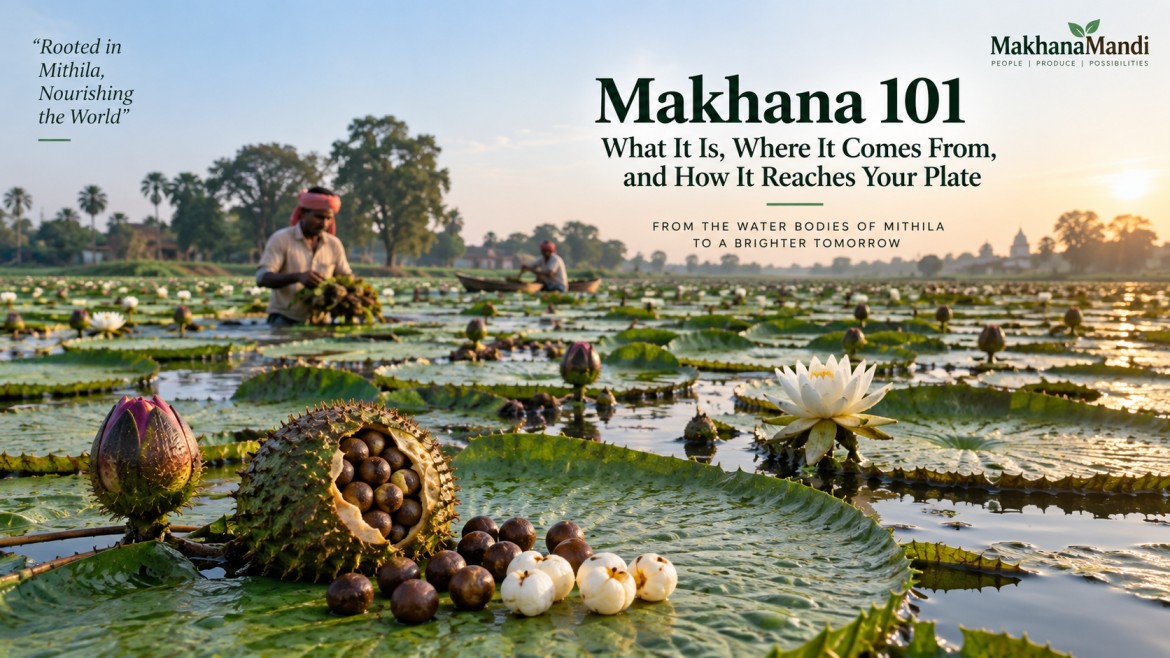
Makhana 101: What It Is, Where It Comes From, and How It Reaches Your Plate ?
Makhana has become increasingly familiar across India and around the world. It is enjoyed as a roasted snack, used in traditional dishes, and increasingly appears in modern food products.
But behind every bowl of popped makhana is a crop, a water body, a farmer, skilled labour, and a long chain of processing and trade.
To understand makhana properly, it is useful to begin at the beginning.
What is Makhana?
Makhana is the edible seed of Euryale ferox, an aquatic plant commonly known as fox nut or gorgon nut.
Unlike many conventional crops, makhana is traditionally cultivated in water bodies such as ponds, wetlands, and other suitable areas with standing water. ICAR describes Euryale ferox as an important aquatic crop and notes that it is commonly grown in stagnant perennial water bodies.
The part that eventually reaches consumers as popped makhana begins as a hard seed.
Through traditional processing and controlled roasting, the seed is transformed into the familiar white, expanded product commonly called popped makhana.
Why is Mithila so closely associated with Makhana?
Makhana has a particularly deep connection with the Mithila region of Bihar.
Traditional makhana cultivation has long been associated with districts such as Darbhanga and Madhubani, where pond-based cultivation remains an important part of the production system. APEDA's study of the makhana value chain also identifies the Mithila region as a major traditional production area.
For generations, the crop has been connected not only with agriculture, but also with the people, water bodies, skills, and rural economy of the region.
This is one reason makhana should not be viewed simply as another packaged snack.
It represents an agricultural value chain with a strong regional identity.
From Water Body to Harvest
Makhana cultivation requires a very different working environment from ordinary field crops.
The plants grow in water, and traditional pond-based cultivation involves specialised knowledge of planting, crop management, harvesting, and handling.
Harvesting is particularly labour-intensive. APEDA's study notes that harvesting in the traditional system is predominantly carried out by workers from the Mallah community, who have specialised experience working in aquatic conditions.
After harvesting, the seeds enter the post-harvest and processing chain.
From Seed to Popped Makhana
The makhana that consumers see in stores is not the same form in which it is harvested.
The harvested seed undergoes several stages of handling and processing before becoming popped makhana.
Traditionally, processing includes drying, grading, heating or roasting, and controlled popping. The skill involved in this process has a direct influence on the appearance, size, texture, and quality of the final product.
This is why the journey from raw seed to finished makhana is just as important as cultivation itself.
Makhana and the GI Identity of Mithila
The regional identity of makhana has also received formal recognition.
Mithila Makhana received a Geographical Indication (GI) registration associated with Bihar. APEDA lists Mithila Makhana as a registered GI product, with the geographical area identified as Bihar.
A GI identity is important because it connects a product with its geographical origin and helps strengthen recognition of the product and its traditional identity.
For the Makhana industry, this creates an important foundation for building greater value around origin, quality, authenticity, and market recognition.
Why Understanding the Value Chain Matters
When we buy a packet of makhana, it is easy to see only the finished product.
But the complete value chain is much larger:
Water body → Cultivation → Harvesting → Raw seed → Processing → Grading → Popped makhana → Packaging → Trade → Consumer
Every stage can influence the final quality and value of the product.
For farmers, important questions include productivity, harvesting costs, storage, and market access.
For processors, quality, grading, processing efficiency, hygiene, and consistency matter.
For buyers and traders, factors such as grade, quality, origin, quantity, packaging, reliability, and commercial terms become important.
And for consumers, the final product needs to be clean, properly processed, safely packaged, and consistent in quality.
Makhana Is More Than a Snack
The growing popularity of makhana is creating new opportunities across the value chain.
But growth should not mean losing sight of the people and practices that have built the industry.
Understanding where makhana comes from is the first step toward understanding its true value.
From the water bodies of Mithila to modern processing facilities and markets across India and beyond, makhana represents a connection between agriculture, traditional knowledge, processing skills, commerce, and modern food consumption.
At MakhanaMandi, we believe that understanding this journey is essential for building a more transparent and connected makhana ecosystem.
And this is only the beginning.