
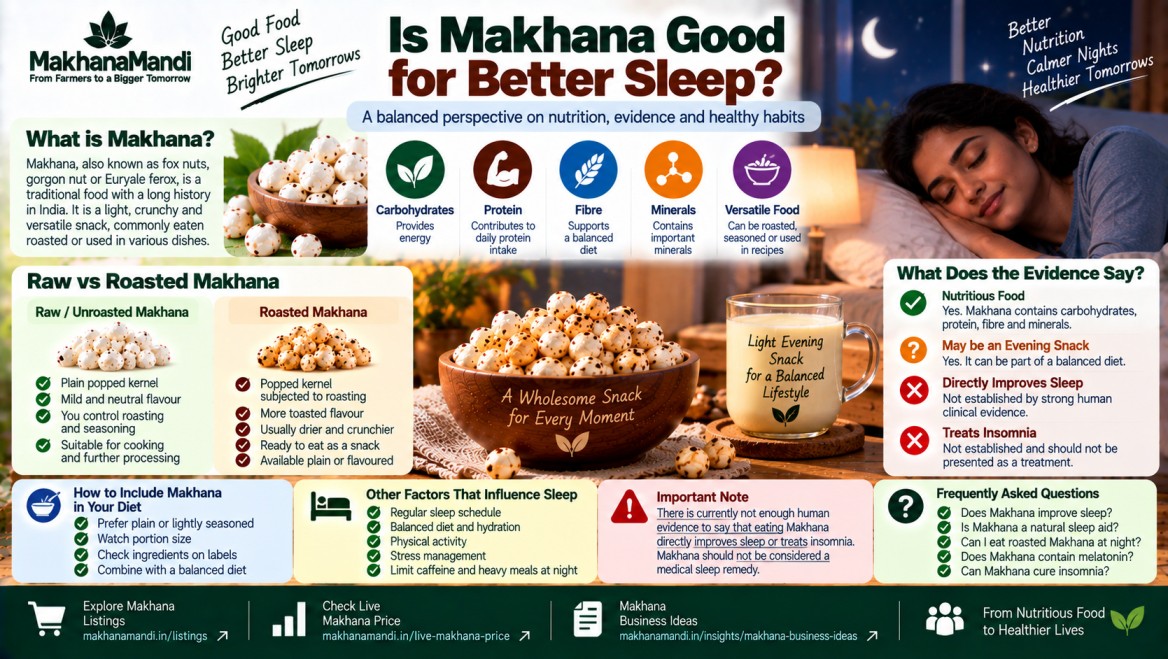
Short answer: Makhana can be part of a balanced diet, but there is currently not enough human evidence to say that eating Makhana directly improves sleep or treats insomnia. Claims that Makhana is a natural sleep remedy should therefore be treated cautiously.
Makhana, also called fox nuts, gorgon nut or Euryale ferox, is a traditional food that is especially important in India's Makhana-producing regions. It is valued for its carbohydrate, protein, fibre and mineral content and is commonly eaten roasted, in snacks and in traditional dishes.
But being a nutritious food is not the same as being a proven sleep aid. So, is Makhana for better sleep a useful idea or simply a popular claim? The answer lies somewhere between nutrition and evidence.
Why do people associate Makhana with better sleep?
Online discussions about Makhana and sleep often connect the food with nutrients, traditional dietary practices and the idea that a light evening snack may be preferable to heavier foods before bedtime.
Makhana does have a useful nutritional profile. Scientific literature describes Euryale ferox as a nutrient-containing food with carbohydrates, protein, fibre and other compounds. However, the presence of nutrients or bioactive compounds does not by itself demonstrate that eating Makhana improves sleep in humans.
This distinction is important because a food can be nutritious without having a clinically demonstrated sleep-promoting effect.
Does scientific research prove that Makhana improves sleep?
At present, no strong human clinical evidence establishes Makhana as a treatment for poor sleep or insomnia.
Research on nutrition and sleep has investigated dietary patterns, macronutrients and individual foods, but the evidence is not sufficient to establish Makhana itself as a sleep treatment.
Research specifically describing Euryale ferox has examined its nutritional composition, traditional uses and various biological activities. These studies provide useful background about Makhana as a food and plant, but they should not be interpreted as proof that eating ordinary Makhana improves sleep quality.
In other words, Makhana may be a sensible food choice, but "Makhana improves sleep" is currently stronger than the available evidence supports.
Makhana nutrition and sleep: what can reasonably be said?
Nutrition can influence sleep, but the relationship is complex. Research has investigated carbohydrates, protein, dietary patterns and other nutritional factors in relation to sleep outcomes. Results vary between studies, and evidence for a direct sleep effect from one particular food remains limited.
That means it is more appropriate to look at Makhana as one component of an overall eating pattern rather than as a standalone sleep intervention.
| Claim | What the evidence supports |
|---|---|
| Makhana is nutritious | Yes. Makhana contains carbohydrates, protein, fibre and minerals. |
| Makhana may be used as an evening snack | Yes. It can be part of a normal balanced diet. |
| Makhana directly increases sleep quality | Not established by strong human clinical evidence. |
| Makhana treats insomnia | Not established and should not be presented as a treatment. |
| Makhana guarantees better sleep | No evidence supports such a guarantee. |
Can Makhana be a good evening snack?
For many people, plain Makhana can be a practical snack because it is light, versatile and easy to prepare. However, whether a particular evening snack works well for an individual depends on total diet, portion size, meal timing and personal tolerance.
Preparation also matters. Plain roasted Makhana is different from Makhana heavily coated with sugar, chocolate, salt, oil or other ingredients. When evaluating a packaged product, look at the complete ingredient list and nutrition information rather than assuming that every Makhana snack has the same nutritional profile.
If you are interested in the difference between forms of Makhana, see our guide to Roasted Makhana vs Raw Makhana.
What about traditional claims about Makhana?
Makhana has a long history of traditional use, particularly in Asian food and traditional medicine systems. Scientific reviews of Euryale ferox document these traditional uses and discuss a range of phytochemicals and biological activities that have been studied experimentally.
Traditional use can provide useful questions for modern research, but it is not equivalent to clinical proof. A traditional claim should therefore not automatically be converted into a medical claim such as "Makhana cures insomnia" or "Makhana increases melatonin."
Does Makhana contain something that makes you sleepy?
There is no established basis for saying that ordinary Makhana consumption produces a clinically meaningful sedative effect.
Makhana contains several nutrients and naturally occurring compounds, and researchers have investigated its phytochemical profile. But identifying a compound in a food is different from demonstrating that consuming the normal food in normal quantities produces a measurable sleep benefit in humans.
This is an important distinction when reading online claims about foods and sleep.
How should you eat Makhana if you want it as an evening snack?
- Prefer simple preparations: Plain or lightly seasoned Makhana gives you more control over added ingredients.
- Watch portion size: A snack still contributes to your total daily food intake.
- Check packaged products: Look at added sugar, salt, oil and flavouring ingredients.
- Consider meal timing: Individual tolerance and eating habits can matter more than choosing one specific food.
- Think about the overall diet: Sleep is influenced by many factors, not one food.
Makhana for sleep: myth or reality?
The most accurate answer is partly myth, partly reasonable nutrition advice.
It is reasonable to include Makhana in a balanced diet and, for people who enjoy it, use plain or lightly prepared Makhana as an evening snack. It is not reasonable to claim that Makhana has been clinically proven to improve sleep, increase sleep hormones or treat insomnia.
The distinction between a nutritious food and a sleep treatment is essential. Current research does not justify turning Makhana into a medical sleep remedy.
Frequently Asked Questions
Does eating Makhana before bed improve sleep?
There is not enough human clinical evidence to establish that eating Makhana before bed directly improves sleep. It can be part of an evening diet, but individual response varies.
Is Makhana a natural sleep aid?
Makhana should not currently be described as a proven natural sleep aid. Scientific evidence supporting a direct sleep-promoting effect from ordinary Makhana consumption is insufficient.
Does Makhana contain melatonin?
Makhana should not be marketed as a melatonin-rich food or a natural source of melatonin without product-specific scientific evidence. Claims about sleep hormones require evidence from appropriate nutritional and clinical studies.
Can I eat roasted Makhana at night?
Roasted Makhana can be eaten as an evening snack if it fits your diet and personal tolerance. Plain or lightly seasoned versions allow greater control over added oil, salt and other ingredients.
Can Makhana cure insomnia?
No. There is no adequate evidence to claim that Makhana cures insomnia. Persistent insomnia or significant sleep problems should be discussed with an appropriate healthcare professional rather than managed solely through a single food.
Is Makhana good for overall nutrition?
Makhana can contribute carbohydrates, protein, fibre and minerals to the diet. Its nutritional value should be considered alongside the preparation method and the rest of the person's diet.
Explore Makhana on MakhanaMandi
If you are interested in Makhana as a food product rather than a health claim, you can explore Makhana listings on MakhanaMandi and compare products available from sellers.
You can also check the live Makhana price page for current market information.
For businesses interested in value addition and commercial opportunities, explore our guide to Makhana business ideas.
References
- PubMed — Influence of nutrition and food on sleep: is there evidence?
- PMC — The Ethnopharmacological, Phytochemical, and Pharmacological Review of Euryale ferox Salisb.
- PubMed — Effects of macronutrient intake on sleep duration and quality: A systematic review
Important: This article provides general food and nutrition information and does not diagnose, prevent or treat insomnia or another medical condition. Evidence about Makhana specifically should not be extrapolated into medical claims without appropriate human clinical research.
